


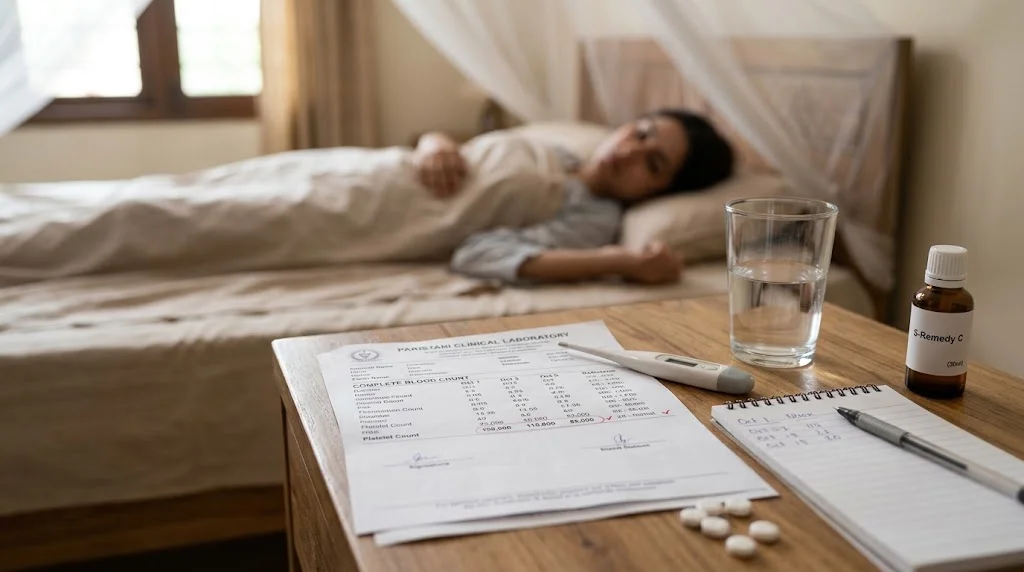
Dengue season in Pakistan brings a familiar, anxious routine for many families: a sudden high fever, a trip to the lab, and then watching the platelet count on each report a little more closely than the last. Searches for homeopathic treatment for dengue fever usually come from people in exactly this situation — looking for safe, supportive ways to ease fever, body ache, and weakness while their doctor manages the condition itself. This article explains what homeopathic supportive care can realistically offer during dengue recovery, what a low platelet count natural remedy approach should and should not be expected to do, and — most importantly — when falling platelets mean it’s time to go to a hospital rather than wait it out at home.
Understanding Dengue Fever and Why Platelets Drop
Dengue is a mosquito-borne viral infection, common across Pakistan during and after the monsoon season, particularly in cities like Lahore, Karachi, Multan, Faisalabad, and Rawalpindi. The infection typically causes sudden high fever, severe headache, pain behind the eyes, joint and muscle pain, nausea, and sometimes a skin rash that appears a few days after fever onset. As the illness progresses, the virus temporarily suppresses the bone marrow’s platelet production and increases platelet destruction, which is why a falling platelet count — thrombocytopenia — is one of the most closely tracked markers during dengue recovery. In most cases, platelet counts recover on their own once the viral phase passes, but a minority of patients develop more serious complications, which is why monitoring matters as much as symptom relief.
What Homeopathic Supportive Care Can Realistically Help With
Homeopathic remedies are traditionally used during dengue fever to provide supportive, comfort-focused relief from symptoms such as high fever, body aches, headache, nausea, and general weakness — not as a treatment for the dengue virus itself or as a way to directly raise platelet count. This distinction matters: supportive care is about helping a patient feel more comfortable while their body and their treating doctor manage the underlying infection, not a substitute for medical monitoring or emergency treatment if the condition worsens.
Commonly used homeopathic remedies associated with dengue-related symptom support include Eupatorium Perfoliatum (traditionally associated with the characteristic deep bone pain of dengue, sometimes called ‘breakbone fever’), China Sulphuricum compound formulations (traditionally used for general weakness and bleeding-tendency symptoms), and Arsenicum Album (traditionally associated with restlessness, weakness, and gastrointestinal symptoms during fever illness). These are mentioned here for general informational context around traditional homeopathic use, not as guaranteed outcomes for any individual case.
Low Platelet Count Natural Remedy Approaches: What to Know
Many Pakistani households search for a low platelet count natural remedy during dengue season, often alongside dietary approaches like papaya leaf extract or pomegranate juice that circulate widely in popular health advice. It’s important to set realistic expectations here: no homeopathic remedy, dietary approach, or home remedy has reliable, well-established clinical evidence proving it raises platelet counts in dengue patients. Platelet recovery in most dengue cases happens as part of the body’s natural recovery from the viral infection, typically within one to two weeks from symptom onset, and is best tracked through regular blood tests ordered by a treating doctor rather than assumed from how a patient feels.
Where homeopathic supportive care fits in this picture is symptom comfort during that recovery window — helping with fever, aches, and general weakness — alongside the rest, fluids, and medical monitoring a doctor recommends, not as a replacement for the blood test schedule or hospital care a doctor advises based on platelet trends.
When Falling Platelets Mean You Need Urgent Medical Care
This is the single most important section of this article. Dengue can, in a minority of cases, progress to Dengue Hemorrhagic Fever or Dengue Shock Syndrome — a genuine medical emergency. Seek immediate medical attention or go to a hospital emergency department if a dengue patient develops any of the following:
- Bleeding from the nose, gums, or in vomit or stool, or unusual bruising
- Severe or persistent abdominal pain
- Persistent vomiting
- Restlessness, confusion, or unusual lethargy, especially as fever appears to subside
- Cold, clammy skin or rapid, weak pulse
- Difficulty breathing
- A rapidly or severely falling platelet count on lab reports, as assessed by the treating doctor
These warning signs, particularly when they appear as the fever starts to come down, can indicate the transition into a more severe phase of dengue and should never be managed with home remedies of any kind, homeopathic or otherwise. A patient showing any of these signs needs hospital-level care, which may include IV fluids, platelet transfusion, or closer monitoring than can be provided at home.
Using Homeopathic Remedies Safely Alongside Medical Treatment
- Always keep your treating doctor informed about any homeopathic or other supportive remedies being used during dengue recovery, particularly given the bleeding risk associated with low platelet counts.
- Continue the full schedule of blood tests your doctor recommends — symptom relief is not a substitute for tracking the actual platelet trend.
- Follow the dosage guidance on the product label or from a qualified homeopathic practitioner; our general dosage guide explains how homeopathic drops and tablets are typically measured and timed.
- Prioritize hydration and rest as advised by your doctor — these remain central to dengue recovery regardless of any supportive remedy being used.
- If symptoms worsen, or any of the warning signs listed above appear, seek medical care immediately rather than continuing home-based supportive measures.
Quality and Safe Sourcing of Homeopathic Remedies
Because dengue involves a genuine bleeding risk, the quality and authenticity of any product used matters more than usual. Warsan is an ISO 9001:2015 and GMP certified homeopathic manufacturer, and products intended for use during fever and dengue-related symptom support, such as China Sulf Tablets & Syrup and Upatoria Tablets, are manufactured under these quality standards. Buyers should always check the DRAP enlistment information on the product label and purchase from verified sources, rather than unverified or informal sellers, particularly for any remedy being used during an active dengue illness.
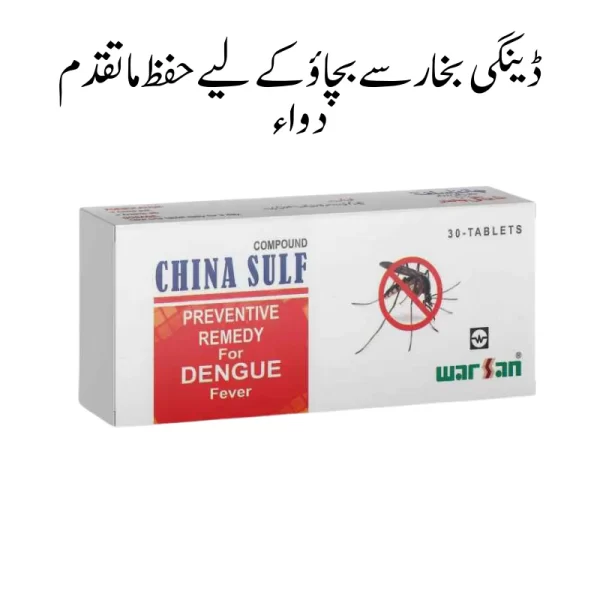
Warsan China Sulf Tablets & Syrup
Warsan Homeopathic · Herbal Products
Explore Warsan China Sulf Tablets & Syrup, mentioned in this guide for supportive relief during recovery, and use it only alongside your doctor’s guidance.
Conclusion
Homeopathic supportive care has a traditional role in easing the fever, body aches, and general discomfort of dengue illness, but it works alongside medical care, not in place of it — and it has no established effect on raising platelet counts. The single most important action for anyone managing dengue fever at home is keeping up with the blood test schedule a doctor recommends and watching closely for the warning signs of severe dengue described above. Warsan’s fever-support products, including China Sulf Tablets & Syrup and Upatoria Tablets, are manufactured under ISO and GMP quality standards for those looking for supportive relief during recovery, always used alongside — never instead of — a doctor’s guidance.