


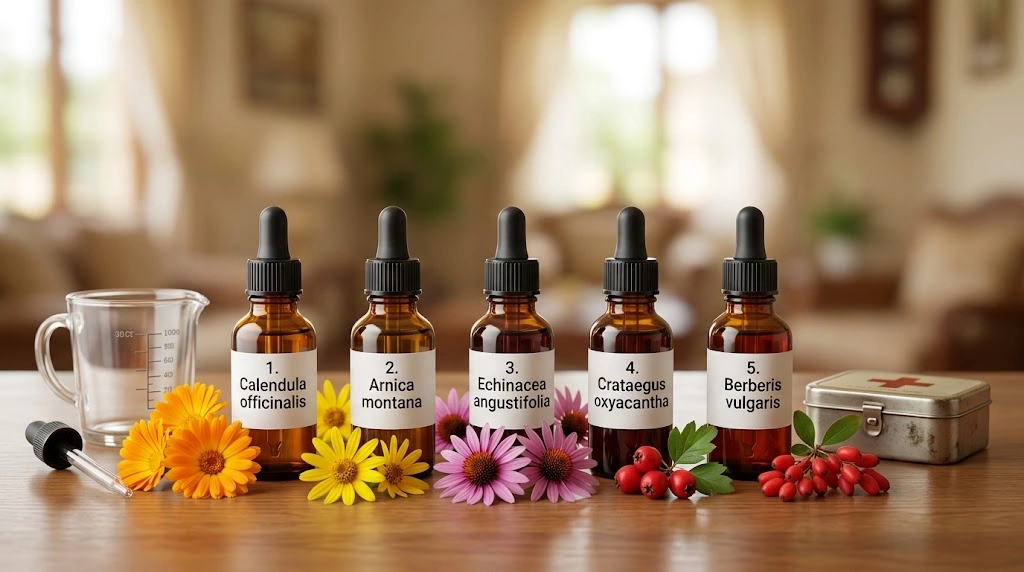
Homeopathic mother tinctures have quietly become a familiar part of many Pakistani households, often kept alongside a digital thermometer and the family’s usual cold remedies. However, many people who pick up a bottle marked “Q” or “MT” may only recognize one or two tinctures by name. This guide to mother tinctures every Pakistani family can understand covers five commonly used mother tinctures, their traditional uses, and practical points to consider when choosing one for the first time.
If you are unfamiliar with the term itself, our guide to mother tincture vs dilution explains the basic difference between a tincture and a diluted potency in more depth. Here, the focus is narrower and more practical: which mother tinctures are worth knowing, and why.

What Is a Mother Tincture, Briefly
A mother tincture is the original liquid extract prepared from a raw plant or mineral source, usually macerated in an alcohol-water base before any further dilution takes place. It is the starting material from which more diluted homeopathic potencies (such as 6X or 30C) are eventually prepared. Because a mother tincture is far less diluted than a potency, it is typically used in small measured doses and is often mixed into water before being taken, or applied externally in the case of skin-related tinctures.Why Pakistani Households Keep Mother Tinctures at Home
Mother tinctures appeal to households for a few practical reasons. They are shelf-stable, need no refrigeration, and a single small bottle can last a household for weeks of occasional use. Many are also used externally as well as internally, which makes a single bottle useful for more than one type of minor household situation. For families already familiar with homeopathy, mother tinctures are often the first products they learn to identify by name, since a handful of them show up repeatedly in general wellness routines and are commonly stocked alongside a home first-aid kit.The Top 5 Mother Tinctures Every Pakistani Household Should Know About
The five mother tinctures below are among the most widely recognized in homeopathic practice worldwide, and each is commonly available in Pakistan’s homeopathic market. As with any homeopathic remedy, exact use, dosage, and suitability for a specific person should be confirmed with a registered homeopath rather than decided from general information alone.1. Calendula Officinalis Q
Calendula, made from the marigold plant, is one of the most recognized mother tinctures for external, topical use. It is commonly applied — usually diluted in water as an external wash or compress — for minor cuts, scrapes, and skin irritation, and is a frequent addition to homeopathic first-aid routines. Because it is generally used externally rather than taken internally, it is often one of the first mother tinctures a household keeps on hand.
Warsan Echinacea Angustifolia Q
Warsan Homeopathic · Mother Tinctures
Explore Warsan Echinacea Angustifolia Q and learn more about the product, ingredients, recommended use, and dosage before use.
VIEW PRODUCT2. Arnica Montana Q
Arnica is closely associated with bumps, bruises, and minor muscular strain, and is one of the most widely known homeopathic remedies for everyday knocks. Mother tincture preparations of Arnica are typically used externally, diluted in water for topical application, rather than taken by mouth undiluted. It is a common household name in homeopathy circles, often mentioned in the same breath as Calendula for minor first-aid situations.3. Echinacea Angustifolia Q
Echinacea is a well-known plant-based remedy that is commonly associated with general immune support, particularly around seasonal changes when colds and minor infections are more frequent. As a mother tincture, it is generally taken in small, diluted doses as directed by a homeopath, and is one of the more familiar names for households that use homeopathy seasonally rather than daily.4. Crataegus Oxyacantha Q
Crataegus, prepared from hawthorn, is traditionally associated with general cardiovascular wellness support within homeopathic practice, particularly for older adults managing routine heart-health concerns alongside their physician’s care. It is not a substitute for prescribed cardiac medication, and anyone with a diagnosed heart condition should only use Crataegus mother tincture under both a physician’s and a homeopath’s guidance.5. Berberis Vulgaris Q
Berberis, made from the barberry plant, is commonly associated in homeopathic practice with general kidney and urinary tract wellness support, including occasional back and flank discomfort. Like the others on this list, it is generally taken in small, diluted doses rather than undiluted, and is best used as part of a plan discussed with a registered homeopath, particularly for anyone with an existing kidney condition.Best Mother Tinctures for Beginners: How to Choose
For someone new to homeopathy, the idea of choosing among dozens of available mother tinctures can feel overwhelming. When people ask about the best mother tinctures for beginners, homeopaths generally point to two considerations rather than a fixed list: how the tincture is meant to be used (external versus internal), and how well-documented and widely available it is. Externally applied tinctures such as Calendula and Arnica are often mentioned as approachable starting points precisely because their traditional use is limited to topical application under simple instructions, while internally taken tinctures such as Echinacea, Crataegus, and Berberis call for more individualized guidance on dosage and duration from a registered homeopath before use. Beginners are also encouraged to start with a single, clearly labeled product rather than experimenting with several tinctures at once, since tracking what helps — or doesn’t — becomes far more difficult when multiple remedies are introduced together.How to Use Mother Tinctures Safely at Home
A few consistent habits apply across nearly every mother tincture, regardless of which one is being used.- Always read the label to confirm the product is marked “Q” or “MT” (mother tincture) rather than a diluted potency, since the two are dosed differently.
- Dilute mother tinctures in water before internal use unless a homeopath has specifically instructed otherwise.
- Use the dropper supplied with the bottle to count drops accurately, and avoid touching the dropper tip to your mouth, skin, or any surface.
- For externally applied tinctures like Calendula or Arnica, use only on unbroken or minor skin surfaces, and stop use if irritation develops.
- Store bottles tightly capped, away from direct sunlight and strong odors, at room temperature.
- Never exceed the dosage printed on the label or advised by your homeopath, and never combine multiple tinctures without professional guidance.
A Practical Example
Consider a hypothetical Pakistani household that keeps three of these tinctures on a shelf: Calendula for the children’s scraped knees, Arnica for the occasional muscle strain after a long day, and Echinacea during the winter cold season. Before using any of them, the parent checks that each bottle is clearly labeled, confirms the dilution instructions on the packaging, and keeps a simple record of which remedy was used for which situation. This kind of basic organization is what most homeopaths recommend for households managing more than one mother tincture at a time.When to See a Homeopath Instead of Self-Treating
Mother tinctures are generally considered a gentle, natural category of remedy when used as directed, but they are not a substitute for professional medical or homeopathic assessment. A homeopath should be consulted before starting any mother tincture for a child, a pregnant or breastfeeding woman, or anyone with a chronic condition such as heart or kidney disease. If symptoms are severe, persistent, or worsening, seek medical attention rather than relying on a mother tincture alone, and never delay emergency care in favor of a home remedy.Common Mistakes Households Make With Mother Tinctures
- Taking an internally-used mother tincture undiluted when the label calls for dilution in water.
- Applying an externally-intended tincture like Calendula to broken or deeply infected skin without medical advice.
- Assuming a mother tincture that helped one family member will automatically suit another, without accounting for individual differences.
- Storing bottles near heat sources or direct sunlight, which can affect the remedy’s stability over time.
- Continuing self-use for weeks without improvement instead of consulting a registered homeopath.