


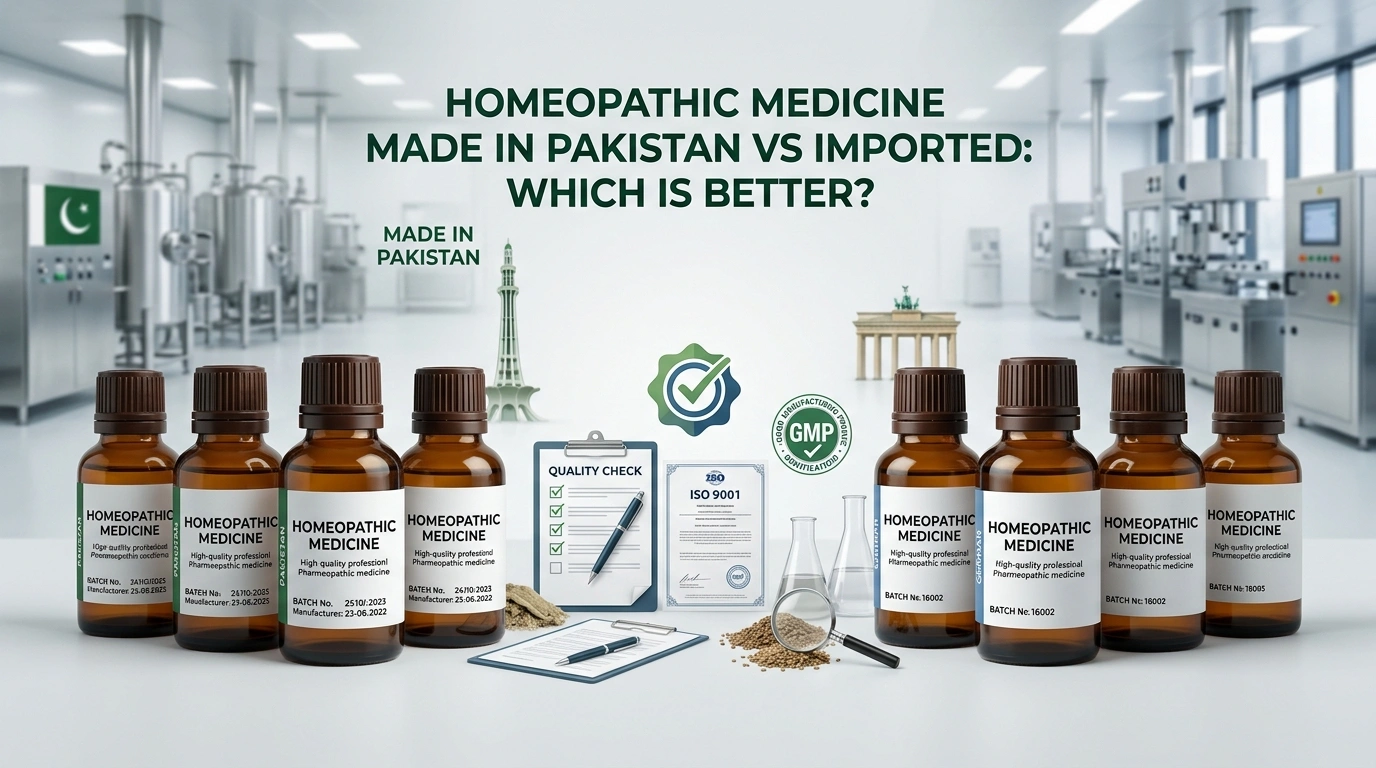
This guide looks at made in Pakistan vs imported homeopathic medicine from a manufacturing-standards perspective. When browsing homeopathic remedies in Pakistan, many buyers instinctively feel that an imported bottle, especially one associated with Germany where homeopathy originated, must be better made than a locally manufactured one. This assumption is worth examining honestly.
This guide looks at homeopathic medicine made in Pakistan vs imported from a manufacturing-standards perspective: what actually differs between the two, what stays the same regardless of origin, and how to judge local vs German imported homeopathic medicine quality using facts rather than assumptions about where a product was made.
Why This Comparison Matters to Pakistani Consumers
Homeopathic medicine is used across Pakistani households for a wide range of everyday complaints, and buyers increasingly want to know whether the country of manufacture genuinely affects safety, purity, or effectiveness. Price also plays a role, since imported products are typically priced significantly higher than locally manufactured equivalents, partly due to shipping, customs duties, and distribution markups rather than necessarily reflecting a difference in preparation quality. Understanding what “made in Pakistan” and “imported” actually mean in practice helps buyers make a more informed decision.
What “Made in Pakistan” Homeopathic Medicine Actually Means
A homeopathic medicine made in Pakistan is manufactured, potentized, and packaged within the country, typically at a facility that must meet local regulatory and quality requirements to legally sell healthcare products. Established Pakistani manufacturers generally follow the same core homeopathic pharmacopoeia standards and the Hahnemannian method of potentization used internationally, meaning the fundamental preparation process is not a simplified or lesser version of what is done abroad. Locally manufactured products also tend to move through a shorter supply chain, from factory to pharmacy shelf, which can mean fresher stock and more direct accountability if a batch-specific question arises.
What “Imported” Homeopathic Medicine Typically Involves
Imported homeopathic medicine, including products sourced from Germany or other established homeopathic-producing countries, must pass through customs clearance, import registration, and a longer distribution chain before reaching a Pakistani pharmacy or online store. This longer journey adds cost and time, and it also means the buyer is more reliant on the local importer or distributor’s own handling and storage practices, since the original manufacturer has no direct oversight once the product leaves their country. Genuine imported products can be high quality, but the import process itself also creates more opportunities for counterfeit or improperly stored goods to enter the market, particularly through informal resellers.
Made in Pakistan vs Imported Homeopathic Medicine: Key Quality Factors
Rather than assuming one origin is automatically superior, it helps to compare the two on the factors that actually affect quality.
- Potentization method — both local and German homeopathic manufacturers generally follow the same Hahnemannian method described in standard homeopathic pharmacopoeias; the country of origin does not change this underlying process.
- Certification — quality depends on whether the specific manufacturer holds recognized certifications such as ISO 9001 and GMP, which exist both locally and internationally; a locally certified manufacturer is not automatically less rigorous than an uncertified imported brand, and vice versa.
- Raw material sourcing and solvent purity — reputable manufacturers, local or imported, use verified raw materials and pharmaceutical-grade alcohol such as Extra Neutral Alcohol (ENA) to keep mother tinctures and dilutions free from impurities.
- Supply chain length — locally manufactured products generally reach the consumer faster and with fewer handling points; imported products travel further and pass through more intermediaries.
- Price — imported products are typically more expensive due to shipping, duties, and distributor margins, which reflects logistics cost more than a guaranteed quality difference.
- Counterfeit risk — informally imported or resold products carry a higher risk of counterfeiting or improper storage compared to medicine bought directly from a certified local manufacturer or its authorized channels.
Does “Imported” Automatically Mean Higher Quality?
No — in homeopathy, the potentization method (the Hahnemannian process) is standardized internationally, so a product’s country of origin does not by itself determine its quality; the manufacturer’s own certifications, raw material sourcing, and quality-control practices matter far more.
This is a genuinely common assumption, partly because homeopathy’s founder, Samuel Hahnemann, was German, which understandably gives German-associated products a reputation for authenticity. However, the preparation method he documented has since been standardized and is followed by certified manufacturers worldwide, including in Pakistan. A locally made product from an ISO and GMP-certified manufacturer can reasonably be expected to meet the same core preparation standards as a certified imported one; conversely, an imported product bought through an unverified reseller carries its own risks around authenticity and storage conditions during transit.
Advantages of Locally Manufactured Homeopathic Medicine in Pakistan
Choosing a homeopathic medicine made in Pakistan offers a few practical advantages worth considering alongside the quality comparison above.
- Shorter supply chains generally mean fresher stock and less time spent in transit or storage before reaching the consumer.
- Local manufacturers are more directly reachable for questions about a specific batch, ingredient, or usage instruction, since there is no international distributor layer in between.
- Locally manufactured products are typically more affordable, since they avoid the shipping, customs duties, and import markups added to genuinely imported goods.
- Buying from an established local manufacturer with a verifiable Pakistani facility and history reduces the risk of encountering counterfeit stock compared to informally imported products sold through unregulated channels.
What to Check Regardless of Origin — Local or Imported
Whichever origin you choose, the same practical checks apply before buying any homeopathic medicine.
- Confirm the manufacturer’s certifications, such as ISO 9001:2015 and GMP compliance, are clearly stated on the packaging or the company’s official channels.
- Check the batch number, manufacturing date, and expiry date printed on the product.
- Buy from the manufacturer’s official website, an authorized pharmacy, or a verified retailer rather than an informal reseller, especially for imported products.
- Read the label for the potency, ingredients, and dosage instructions, and consult a qualified homeopath if anything is unclear.
A Practical Example
Consider a hypothetical example: a consumer in Karachi is choosing between a locally manufactured homeopathic tonic from an ISO and GMP-certified Pakistani company and a similar imported product from an online reseller with no clear certification listed. Rather than assuming the imported option is automatically better because of its origin, they check both products’ labels for certification, batch details, and expiry dates, and ultimately choose the locally manufactured option because its certifications are verifiable and its manufacturer is directly reachable for questions. This illustrates how checking specific quality markers is more useful than relying on country of origin alone.
How Warsan Approaches Local Manufacturing Standards
Warsan Homoeopathic has been manufacturing homeopathic medicines in Pakistan since 1977, operating its own manufacturing facility under ISO 9001:2015 and GMP-certified conditions. The company states that it uses authenticated raw materials and Extra Neutral Alcohol (ENA) to keep its mother tinctures and dilutions free from impurities, and that its medicines are prepared according to standard homeopathic pharmacopoeias using the Hahnemannian method of potentization, the same core process referenced internationally. This positions Warsan as an example of a Pakistani manufacturer applying the same foundational standards associated with well-regarded imported homeopathic medicine, while offering the shorter supply chain and direct accessibility of a local producer.
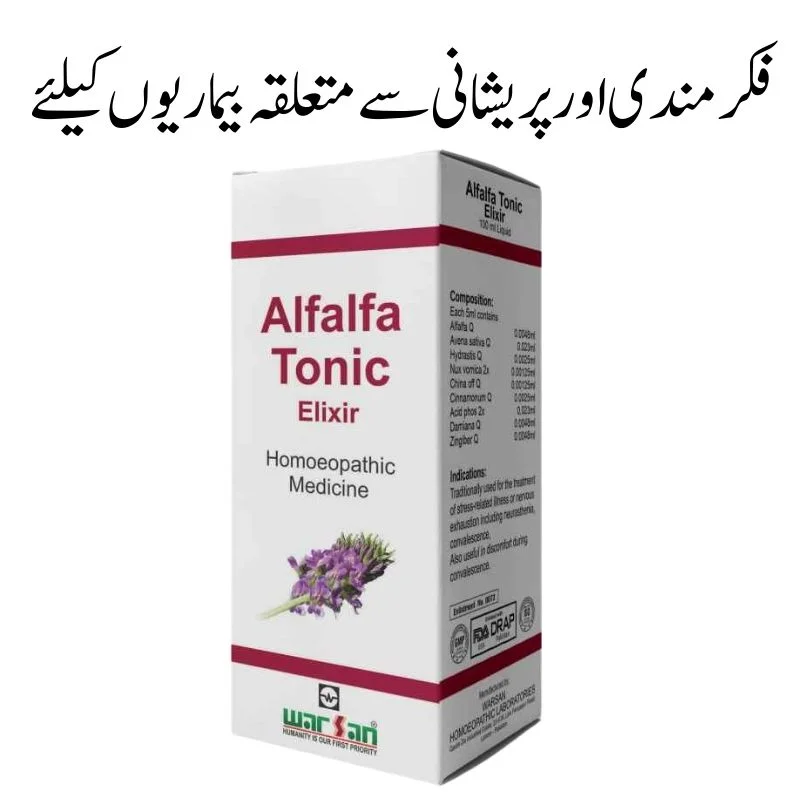
Alfalfa Tonic Elixir Syrup
Alfalfa Tonic Elixir is a premier homeopathic remedy formulated to relieve physical and mental exhaustion, nervous fatigue, and support recovery during convalescence naturally.
Signs of a Counterfeit or Poorly Handled Product
Whether buying local or imported, a few warning signs suggest a product may not be genuine or may have been poorly stored during a long supply chain.
- Packaging that looks inconsistent with the manufacturer’s official branding, or labeling with spelling errors and missing batch information.
- A price that seems unusually low for what is claimed to be an imported, certified product, which can indicate counterfeit stock.
- No verifiable way to contact the manufacturer or confirm the product’s certification and registration status.
- Liquid remedies that appear discolored, cloudy, or have an unusual odor, which can result from poor storage during a long or informal import journey.
If any of these signs are present, it is safer to buy from a different, verifiable source rather than risk using an uncertain product.
Regulatory Considerations for Homeopathic Medicine in Pakistan
Homeopathic medicines sold in Pakistan, whether locally manufactured or imported, are expected to comply with applicable local regulatory requirements before they can be legally marketed. For imported products, this generally means the importer or distributor is responsible for ensuring the product has been properly registered and cleared for sale in Pakistan, in addition to whatever registration it holds in its country of origin. For locally manufactured products, the manufacturer itself is directly responsible for meeting these requirements at the point of production. Buyers who want additional assurance can look for products that clearly state their regulatory compliance and manufacturer details on the packaging, rather than relying on country of origin as a stand-in for regulatory approval.