



Millions of Pakistanis are searching for a reliable natural blood sugar control remedy — and many are turning to homeopathy after years of frustration with side effects, rising medication costs, and blood sugar readings that still won’t cooperate. Pakistan now has one of the highest rates of diabetes in the world, with over 33 million people living with the condition. That number is expected to climb.
If you or someone in your family has been told their HbA1c is too high, or you’re already on medication but still not feeling well, you’re not alone. Many patients come to us having tried everything — and still feeling stuck. What they often haven’t tried is a properly matched homeopathic approach that addresses the underlying imbalance, not just the glucose number.
In this article, you’ll learn how homeopathic remedies may support blood sugar regulation, which remedies are most commonly used in Pakistan, and how Warsan Homoeopathic Laboratories has been helping patients manage diabetes naturally for nearly five decades.
This article is for educational purposes and is not medical advice. Please consult a qualified homeopathic practitioner before starting any remedy.
What Is Diabetes — and Why Do So Many Pakistanis Suffer From It?
Diabetes mellitus (ذیابیطس), known widely in Pakistan as “sugar ki beemari,” is a metabolic condition in which the body either cannot produce enough insulin or cannot use it effectively. This causes glucose to build up in the blood instead of being absorbed into cells for energy.
Pakistan carries a heavy burden. According to the International Diabetes Federation, Pakistan ranks among the top ten countries globally for diabetes prevalence. Urban centres like Lahore and Karachi show particularly high rates, driven by a combination of genetic predisposition, high-carbohydrate diets rich in white rice, naan, and sweets, sedentary lifestyles, and rising stress levels.
There are two primary types. Type 1 diabetes involves the immune system destroying insulin-producing cells — it’s less common but requires lifelong insulin therapy. Type 2 diabetes is far more prevalent and is strongly linked to lifestyle. There’s also gestational diabetes and prediabetes, both of which are underdiagnosed in Pakistan.
What makes diabetes particularly dangerous is its silence. Many people live with elevated blood sugar for years without symptoms, until complications like nerve damage, kidney disease, or vision problems appear. This is why early, consistent management — including supportive approaches like homeopathy — matters so much.
How Does Homeopathy Help with Diabetes?
Homeopathy works on the principle of “like cures like” — substances that produce certain symptoms in a healthy person may, in highly diluted form, stimulate the body to correct similar symptoms in an unwell person. For diabetes, this means using remedies that support the pancreas, improve cellular sensitivity to insulin, reduce sugar cravings, and address the accompanying symptoms like fatigue, excessive thirst, and frequent urination.
Homeopathy doesn’t claim to replace insulin therapy. What it does — and what we’ve observed at Warsan Homoeopathic Laboratories over 47 years — is help the body respond better to its condition. Patients who add well-matched homeopathic remedies to their management plan often report more stable energy, reduced thirst, and in many Type 2 cases, a gradual improvement in fasting glucose levels when combined with dietary changes.
The mechanism isn’t about one chemical blocking another. It’s about shifting the body’s regulatory patterns. A well-prescribed remedy chosen for the whole patient — their temperament, their specific symptoms, their history — works differently from a blanket supplement. That’s the genuine difference between homeopathy and simply taking herbal extracts.
As a GMP-certified manufacturer since 1977, Warsan Homoeopathic has formulated products specifically for Pakistani patients, accounting for local diet, climate, and the most commonly seen symptom profiles in clinics across the country.
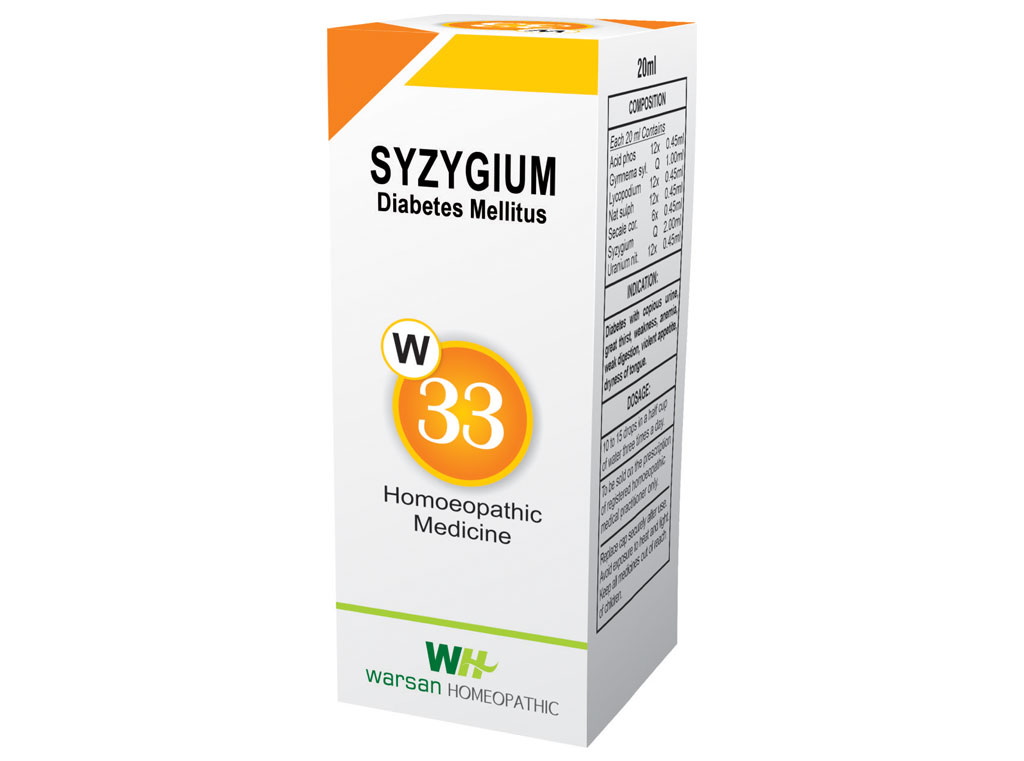
Warsan No. 33 (Syzygium) 20ml
Top Homeopathic Remedies for Diabetes in Pakistan
Syzygium Jambolanum (Jambolan) — Q (Mother Tincture)
Syzygium jambolanum for diabetes is arguably the most well-known homeopathic remedy for blood sugar support. Made from the seeds of the jambolan (jamun) fruit, it has a long history of use in South Asian traditional medicine — and now a solid track record in homeopathic practice. It’s primarily indicated when blood sugar is persistently high, when there is excessive thirst and urination, and when the urine shows high sugar content. Taken as 10 drops in water three times daily (mother tincture form), it’s one of the gentlest entry points for new patients exploring homeopathy.
Uranium Nitricum — 3X or 6X
This remedy is indicated for patients with significant thirst, excessive urination, and notable weight loss despite eating well — a picture that often accompanies poorly controlled Type 2 diabetes. It’s also used when there’s accompanying liver or kidney involvement. Practitioners often prescribe it in 3X potency, taken two to three times daily.
Phosphoric Acid — 6X or 30C
A go-to remedy when diabetes is accompanied by profound mental and physical exhaustion. The patient feels “drained” — often after grief, loss, or chronic overwork. Phosphoric acid suits the tired professional in Karachi or the emotionally depleted caregiver who finds their blood sugar has crept up alongside their stress. It addresses the fatigue and debility that standard blood sugar medications don’t touch.
Lycopodium Clavatum — 30C
Lycopodium is often indicated for diabetic patients with digestive issues — bloating after eating, a preference for sweet foods, and symptoms that worsen in the late afternoon. It’s particularly relevant for patients who show liver involvement alongside elevated glucose. It’s also suited for individuals who feel more anxious about their condition than they let on.
Insulinum — 6C or 30C
Made from insulin itself, this remedy is used homeopathically to support patients whose pancreatic function is compromised. It’s not a substitute for prescribed insulin, but some practitioners use it as a complementary support alongside conventional treatment. It’s typically prescribed by a practitioner rather than self-administered.
Calcarea Phosphorica — 6X
Useful for children or adolescents with Type 1 diabetes, or adults who are constitutionally weak, thin, and prone to catching infections. It addresses the nutritional absorption issues that often accompany long-term blood sugar imbalance.
💡 Expert Tip: No two diabetic patients present the same way in a homeopathic consultation. A 55-year-old woman in Lahore with fatigue and depression needs a different remedy than a 40-year-old man in Peshawar with digestive bloating and anxiety. Always work with a qualified practitioner for the best-matched prescription — the right remedy at the right potency makes all the difference.
🌿 Warsan Product Recommendation
Looking for a ready-made formulation? Warsan Homoeopathic’s Diabetes Support Formula combines key remedies including syzygium jambolanum and uranium nitricum in a balanced potency, manufactured under GMP-certified conditions at our facility that has been trusted by Pakistani families since 1977.
Visit warsan.com.pk to explore the full range. You can buy homeopathic medicine online in Pakistan directly from our website, with delivery across Lahore, Karachi, Islamabad, and all major cities.
For personalised guidance, we strongly recommend booking a consultation with a qualified homeopathic practitioner who can assess your full symptom picture before recommending potency and dosage.
How to Use Homeopathic Remedies — Dosage, Timeline & Lifestyle Tips
Homeopathic remedies work best when taken on a clean palate — ideally 15–30 minutes before or after eating, coffee, or strong flavours like peppermint. In Pakistan, where chai is practically a meal, it’s worth timing your doses around it.
Potency matters as much as the remedy name. Lower potencies (6X, 3X) are generally used for physical, organ-level support and may be taken two to three times daily. Higher potencies (30C and above) are used less frequently and should ideally be prescribed by a practitioner.
Timelines vary by individual. Some patients notice improved energy and reduced thirst within two to three weeks. Meaningful changes in fasting glucose often take two to three months of consistent use, combined with dietary adjustments — reducing refined sugar, white flour, and fried foods while increasing whole grains, vegetables, and lean protein.
Lifestyle integration is non-negotiable. A remedy won’t override daily mithai and a sedentary routine. Even a 20-minute walk after dinner, a well-documented strategy for post-meal glucose control, can amplify the effect of homeopathic treatment significantly.
📌 Did You Know? Jamun (jambolan) seeds have been used in the subcontinent for blood sugar management for over 2,000 years — long before the formal development of homeopathy. Syzygium jambolanum for diabetes essentially formalised this folk knowledge into a standardised remedy with consistent potency and dosing.
Common Mistakes That Prevent Recovery
Switching remedies too quickly. Homeopathy requires patience. If you don’t see dramatic results in three days and switch to another remedy, you’ll never know what the first one might have done. Give a well-selected remedy at least four to six weeks before reassessing.
Self-prescribing at high potencies. Buying a 200C remedy online and taking it daily without a practitioner’s guidance is one of the most common mistakes we see. High potencies can aggravate symptoms before they improve, and without oversight, patients interpret this as the remedy not working and stop prematurely.
Continuing with dietary habits that undermine the treatment. Homeopathic remedies work with the body’s regulatory systems — they can’t override a diet that floods those systems with glucose hourly. Patients who don’t adjust their eating see far slower results.
Using strong substances that antidote the remedy. Coffee, camphor, menthol, and some essential oils are known to interfere with certain remedies. Ask your practitioner which substances to avoid during treatment.
Homeopathy vs. Conventional Medicine — A Fair Comparison
Allopathic diabetes medications — metformin, sulfonylureas, insulin — are well-researched, fast-acting, and essential for many patients, particularly those with Type 1 diabetes or advanced Type 2. We at Warsan Homoeopathic have always been clear: conventional medicine saves lives, and anyone requiring insulin should never discontinue it without medical supervision.
Where homeopathy adds genuine value is in the spaces allopathy doesn’t fully address — the fatigue that lingers even when glucose is controlled, the anxiety around the condition, the digestive symptoms, and the quality of life that numbers alone don’t capture.
Many patients use both approaches together. A patient on metformin who adds a well-matched homeopathic remedy often finds their energy improves, their readings stabilise further, and they need fewer dose increases over time. This integrated approach — what we’d call diabetes holistic management — is not about replacing one system with another. It’s about using each where it performs best.
The key is communication. Tell your GP or endocrinologist what homeopathic remedies you’re taking, and tell your homeopath what conventional medications you’re on. Transparency makes the combination safer and more effective.
Conclusion
Managing diabetes well in Pakistan is genuinely possible — but it requires more than just monitoring glucose readings. A natural blood sugar control remedy used correctly, within a broader lifestyle and dietary framework, can meaningfully improve how you feel and how your body regulates sugar over time.
Three things to remember: First, homeopathy works best when the remedy matches the whole person, not just the diagnosis. Second, remedies like syzygium jambolanum for diabetes have decades of clinical use behind them and should be part of every Pakistani patient’s conversation with their homeopath. Third, diabetes holistic management means combining the best of all available approaches — and Warsan Homoeopathic has been helping Pakistani families do exactly that since 1977.
Frequently Asked Questions
1. Can homeopathy cure diabetes permanently?
Homeopathy does not claim to cure diabetes permanently. What homeopathic remedies may support is better regulation of blood sugar, improved energy, and reduced symptom burden — particularly in Type 2 diabetes when combined with dietary changes. Using the best homeopathic medicine for diabetes in Pakistan means working with a practitioner to find the right individualised prescription, not expecting a single remedy to replace comprehensive management.
2. What is the best natural blood sugar control remedy in homeopathy?
Syzygium jambolanum (mother tincture) is widely considered the most well-known natural blood sugar control remedy in homeopathic practice, particularly in South Asia. It’s made from jambolan (jamun) seeds and has a long history of traditional use. However, remedies like uranium nitricum, phosphoric acid, and lycopodium are equally important — the “best” remedy depends entirely on the individual patient’s symptom picture.
3. How does syzygium jambolanum for diabetes work?
Syzygium jambolanum for diabetes is believed to support the pancreas and help reduce excess sugar in the blood and urine. In homeopathic practice, it’s indicated specifically when there is significant thirst, frequent urination, and high urine sugar. It’s typically used as a mother tincture (Q), taken 10 drops in water two to three times daily, and is one of the safer remedies for initial self-use under basic guidance.
4. Is homeopathic medicine safe to take alongside metformin or insulin?
Generally, homeopathic remedies are considered safe alongside conventional diabetes medications, as they work on different principles and are used in highly diluted forms. However, always inform both your allopathic doctor and your homeopath about everything you’re taking. Never reduce or stop insulin without medical supervision. Combined diabetes holistic management works best with full transparency between all practitioners involved.
5. How long does it take to see results from homeopathic treatment for diabetes?
Most patients notice improvements in energy and thirst levels within two to four weeks of starting a well-matched remedy. Changes in fasting blood glucose readings typically take two to three months to become apparent. Homeopathy is not a rapid-acting intervention — it works gradually by supporting the body’s own regulatory mechanisms, which requires patience and consistent use alongside dietary adjustments.
6. Can I buy homeopathic medicine for diabetes online in Pakistan?
Yes. Warsan Homoeopathic Laboratories offers a range of formulations available to buy homeopathic medicine online in Pakistan through warsan.com.pk, with delivery across Lahore, Karachi, Islamabad, and other major cities. For complex or longstanding cases, it’s strongly recommended to consult a practitioner before ordering, as the right remedy depends on your specific symptom picture and health history.
7. Are there homeopathic remedies safe for diabetic children?
Yes, certain remedies like calcarea phosphorica are commonly used for younger patients, particularly those with Type 1 diabetes or poor nutritional absorption. Homeopathy is generally gentle and well-tolerated in children. Always consult a qualified homeopathic practitioner for children’s prescriptions, as potency and dosage differ from adult protocols. Self-prescribing for children is not recommended.
8. What lifestyle changes work best alongside homeopathic treatment for diabetes in Pakistan?
Reducing refined carbohydrates — white rice, naan, sugary drinks, mithai — while increasing fibre, vegetables, and lean protein forms the foundation. A 20-minute post-meal walk helps regulate post-meal glucose significantly. Stress management is also essential, as chronic stress elevates cortisol, which directly raises blood sugar. In our experience at Warsan Homoeopathic, patients who combine remedy use with even modest lifestyle adjustments see substantially better results than those relying on the remedy alone.