

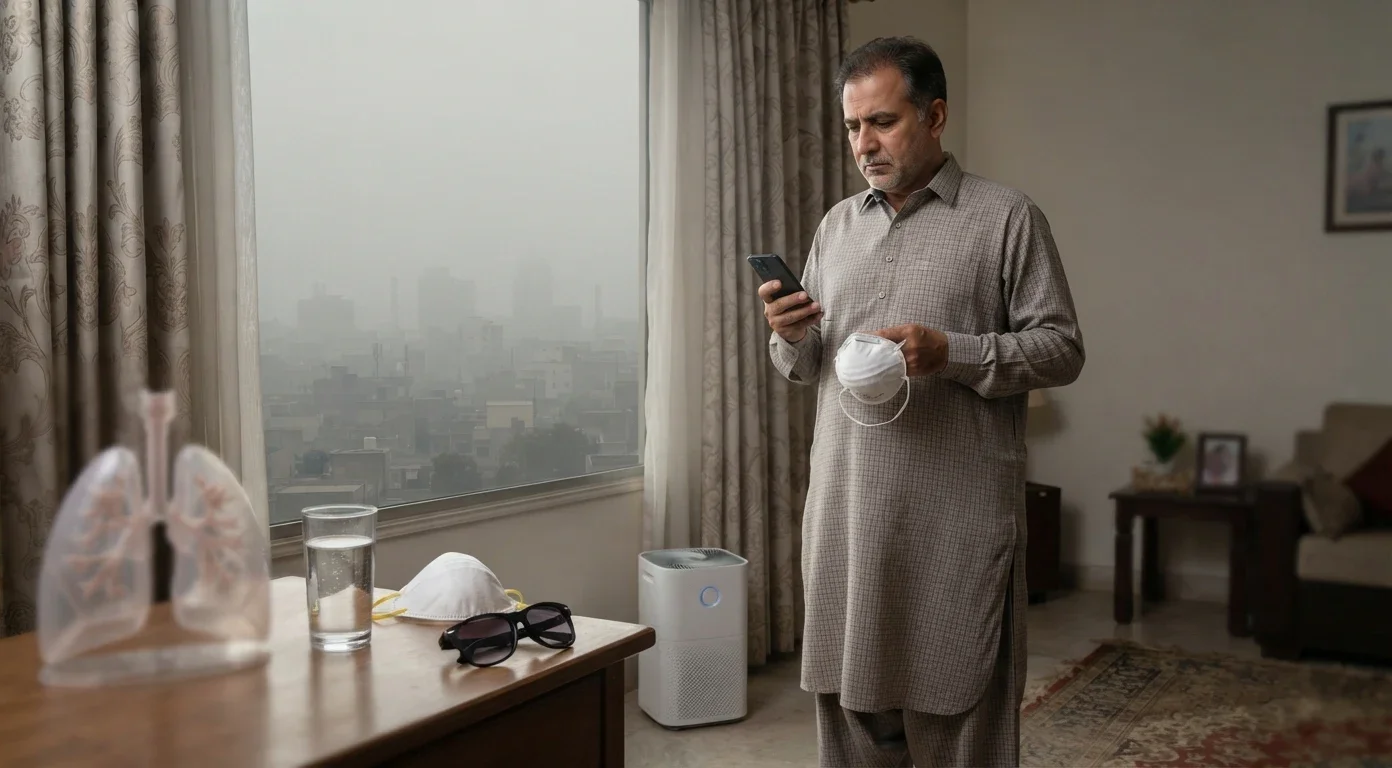
Somewhere around the last week of October, Lahore quietly changes. The mornings turn soft and grey, the sun becomes a dim coin behind a haze, and by the time most people are finishing breakfast, their throat already feels a little scratchy. This isn’t fog. It’s smog season, and in November 2026, it has been especially brutal — Lahore has repeatedly topped IQAir’s list of the world’s most polluted major cities, with the Air Quality Index (AQI) crossing 500 on several mornings and even forcing the Pakistan–Sri Lanka Test match to be relocated from Gaddafi Stadium to Rawalpindi.
If you live in Lahore, none of this is news. What’s often missing is a clear, practical answer to the question everyone quietly asks every winter: what is this actually doing to my body, and what can I realistically do about it? This guide walks through both — the science of why Lahore’s air turns toxic each winter, what it does to your lungs, throat and eyes, and the protective steps worth taking, along with where gentle, supportive care can reasonably fit alongside the medical advice that matters most.
Why Lahore’s Air Turns Toxic Every Winter
Smog isn’t just fog with a bad reputation — it’s a mix of smoke and fog, formed when pollutants get trapped close to the ground. Three things come together every year to make this worse in Lahore specifically:
- Crop residue burning — farmers across Punjab and neighbouring Indian states burn leftover stubble after the harvest, releasing huge amounts of smoke that drifts toward Lahore on seasonal winds.
- Vehicle and industrial emissions — Lahore’s traffic and industrial activity continuously pump out fine particles and gases that, on a clear day, would disperse upward.
- A cold-weather “lid” effect — as temperatures drop, a layer of cold air settles close to the ground while warmer air sits above it, trapping smoke, dust and vehicle exhaust rather than letting it rise and disperse.
Dera Ghazi Khan, Kot Addu and Nankana Sahib have recorded AQI readings around 500 this season, and Pakistan’s Meteorological Department has warned that smog intensity typically keeps building from November into mid-December, according to Punjab’s disaster management authority.
Just How Bad Is the Air Right Now?
To put Lahore’s November 2026 numbers in perspective: the World Health Organization’s current guideline for safe annual PM2.5 exposure is 5 micrograms per cubic metre, with a 24-hour guideline of 15. On several mornings this month, Lahore’s PM2.5 readings have been reported well above 300, and some neighbourhoods, such as Allama Iqbal Town, have recorded AQI figures above 700 — a level air-quality trackers classify as “hazardous.”
Local doctors have taken to describing bad smog days in blunt terms: breathing Lahore’s air on a severe smog day has been compared to smoking roughly ten cigarettes, a comparison Lahore-based Shalamar Hospital has used to help residents grasp the scale of the exposure. Whether or not the exact cigarette-equivalent math holds up to scrutiny, the underlying point is accurate — this isn’t a mild inconvenience, it’s a genuine public health event, serious enough that Punjab has run province-wide anti-smog crackdowns, deployed mist-spraying “anti-smog guns,” and adjusted school timings this season.
What Smog Actually Does to Your Lungs, Throat and Eyes
The fine particles in smog — especially PM2.5, which is small enough to penetrate deep into the lungs — don’t just sit on the surface of your airways. Here’s a breakdown of what residents and doctors across Lahore consistently report during smog season:
Your Lungs
Fine particulate matter can irritate and inflame the airways, triggering coughing, shortness of breath and chest tightness. People with asthma or other chronic lung conditions are especially vulnerable, and local hospitals report hundreds of patients arriving daily with breathing difficulties during peak smog weeks. Long-term exposure is linked by the WHO to reduced lung function and a higher risk of chronic respiratory disease over time.
Your Throat
Lahore residents consistently describe the same experience each winter: a dry, scratchy throat that seems to start the moment they step outside, sometimes progressing to a persistent cough or a feeling of throat “burning.” This happens because airborne particles and irritant gases directly inflame the mucous membranes lining the throat.
Your Eyes
Smog is a direct eye irritant. Many residents report redness, itching, and a watery, gritty sensation, with doctors noting an increased risk of conjunctivitis during smog season. Children, who rub their eyes more, are often among the worst affected.
Who Is Most at Risk
While everyone feels the effects to some degree, certain groups face meaningfully higher risk:
- Children — their lungs are still developing, their airways are smaller, and they typically breathe faster and spend more time playing outdoors.
- Older adults — age-related decline in lung and heart function makes it harder to cope with added pollution stress.
- People with asthma, COPD or heart disease — smog can trigger flare-ups and has been linked by health researchers to increased cardiovascular strain.
- Pregnant women — some research associates heavy air pollution exposure during pregnancy with health risks, making extra caution reasonable.
- Outdoor workers and commuters — traffic police, delivery riders and anyone spending long hours outdoors get a much higher cumulative dose.
Practical, Realistic Protection Tips
None of this means Lahore residents are powerless. A combination of small, consistent habits makes a real difference:
- Check the AQI before you plan your day. Apps like IQAir and Punjab’s own Environment Protection Department dashboard give live readings by area — treat anything above 150 as a signal to limit outdoor time, and above 300 as a strong reason to stay indoors.
- Wear a well-fitted N95 or KN95 mask outdoors. Ordinary cloth or surgical masks filter out very little PM2.5; an N95 that seals properly around the nose and chin offers meaningfully better protection.
- Keep windows and doors closed during peak smog hours, typically early morning and late evening, and run an air purifier with a HEPA filter indoors if you have access to one.
- Avoid outdoor exercise on severe smog days. A brisk walk or jog pulls far more polluted air deep into your lungs than normal breathing does — shift workouts indoors during hazardous AQI days.
- Protect your eyes with sunglasses outdoors, and consider preservative-free artificial tears if irritation is frequent, a step several Lahore hospitals have specifically recommended this season.
- Rinse your nasal passages and gargle with warm salt water in the evening to help clear trapped particles from your throat and nose after a day outside.
- Support your body’s resilience with a few antioxidant-rich foods — citrus fruits, leafy greens, berries and nuts are often suggested by nutritionists as a general, sensible habit during high-pollution weeks, though they’re a supplement to precautions, not a substitute for them.
The Technology Side: How Lahore Is Tracking and Fighting Smog
Smog management in Punjab has become noticeably more data-driven in recent years. The Punjab Environment Protection Department now runs a real-time air quality dashboard covering multiple cities, giving residents far more granular, up-to-date readings than were available even a few years ago. On the response side, authorities have deployed anti-smog guns (vehicles that spray a fine water mist to settle airborne particles) across badly affected areas, alongside renewed interest in cloud-seeding and artificial rain as a longer-term mitigation tool. For individual households, the same shift is visible on a smaller scale: affordable indoor air quality monitors and HEPA air purifiers, once rare in Pakistani homes, are becoming far more accessible, giving families a practical way to see — not just guess at — the air they’re actually breathing indoors.
When to See a Doctor, Not Just Take Precautions
Most smog-related discomfort — a scratchy throat, watery eyes, mild coughing — settles once air quality improves, as it visibly did on November 13, 2026, when rain brought Lahore’s AQI down from the 400s to around 111 within a day. But certain symptoms need prompt medical attention rather than home care alone:
- Shortness of breath that doesn’t ease with rest
- Chest pain or tightness, especially in anyone with existing heart or lung disease
- A cough that persists, worsens, or brings up blood
- Wheezing or an asthma flare-up that isn’t controlled by a usual inhaler
- High fever alongside breathing difficulty, which could indicate a respiratory infection rather than simple irritation
If you or a family member experience any of these, seeing a doctor is the right next step — smog can both trigger new problems and worsen existing conditions like asthma and heart disease, and self-management alone isn’t appropriate once symptoms become more than mild irritation.
Where Supportive Care Fits
Once the precautions above are in place and any serious symptoms have been properly checked by a doctor, some Lahore households also look at gentle, complementary options to help manage ongoing throat and respiratory discomfort during smog season — alongside, never instead of, the medical and preventive steps that matter most. If you’re exploring this route, Warsan’s respiratory-support product range is worth a look as one option among several, with the same rule applying here as everywhere else in healthcare: check the specific product’s label, understand what it’s actually meant to do, and continue following medical advice for anything beyond mild, everyday irritation. No natural or homeopathic product should be relied on as a substitute for seeing a doctor when breathing difficulty, chest pain, or a worsening chronic condition is involved.
A Realistic Household Routine for Smog Season
Pulling this together, a sensible daily routine during Lahore’s worst smog weeks looks less like a strict regimen and more like a short checklist: check the AQI before stepping out, mask up properly if it’s high, keep the home sealed and running a purifier where possible, rinse off pollution exposure in the evening, and stay alert to symptoms that go beyond ordinary irritation. None of these steps are dramatic on their own, but together they meaningfully reduce the daily dose of pollution your family is exposed to.
The Bigger Picture
It’s worth being honest about one thing: no household-level precaution fixes Lahore’s smog problem. That requires the kind of structural, government-and-regional-level action already underway in parts — stricter controls on crop burning, vehicle emissions and industrial pollution, cross-border cooperation given how much smoke drifts in from neighbouring regions, and sustained investment in cleaner transport and energy. Until that long-term work pays off, the realistic goal for most families is damage limitation: knowing the numbers, taking sensible daily precautions, and getting the right medical help when symptoms cross the line from irritating to concerning.
A Meaningful Takeaway
Smog season in Lahore isn’t going away this winter, and probably not next winter either. But the gap between “just living with it” and “actively managing it” is smaller than it feels — a mask that actually fits, a habit of checking the AQI before you leave home, and knowing which symptoms deserve a doctor’s attention rather than another cup of tea, can genuinely change how this season affects your family’s health.
Frequently Asked Questions
Q1: What AQI level is considered dangerous in Lahore?
Air quality trackers generally classify an AQI above 150 as unhealthy for sensitive groups, above 200 as unhealthy for everyone, and above 300 as hazardous. Lahore has recorded readings well above 500 on several mornings this November, which falls firmly in the hazardous range.
Q2: Do cloth masks protect against smog?
Not very well. Ordinary cloth and surgical masks are designed mainly to block larger droplets, not the fine PM2.5 particles that make up most of smog’s health risk. A properly fitted N95 or KN95 mask offers significantly better filtration.
Q3: Is it safe to exercise outdoors during smog season?
On days with high or hazardous AQI readings, it’s best to move exercise indoors. Physical exertion increases how deeply and quickly you breathe in polluted air, which can meaningfully increase your exposure compared to normal daily activity.
Q4: Why does Lahore's smog seem worse than other Pakistani cities?
Lahore sits in a flat plain surrounded by heavily farmed land, with dense traffic and industry of its own, and it also receives drifting smoke from crop burning in neighbouring regions. Cold, still winter air then traps all of this close to the ground, concentrating pollution more than in cities with different geography or wind patterns.
Q5: Can children go to school during severe smog?
Authorities in Punjab have adjusted school timings and, in some past years, ordered temporary closures during the worst smog spells. Parents should follow official school and government guidance for their specific area, since this changes based on daily AQI readings.
Q6: Does rain actually clear the smog?
Yes, meaningfully. Lahore’s AQI dropped from the 400s to around 111 within a day after rainfall on November 13, 2026, since rain washes airborne particles out of the atmosphere. However, smog typically returns once dry, still conditions resume.
Q7: Can homeopathic or natural products cure smog-related symptoms?
No. Mild throat or respiratory discomfort from smog exposure may be supported by gentle, natural approaches alongside proper precautions, but no homeopathic or natural product should be treated as a cure, and anything beyond mild irritation — difficulty breathing, chest pain, a worsening cough — needs proper medical evaluation.