


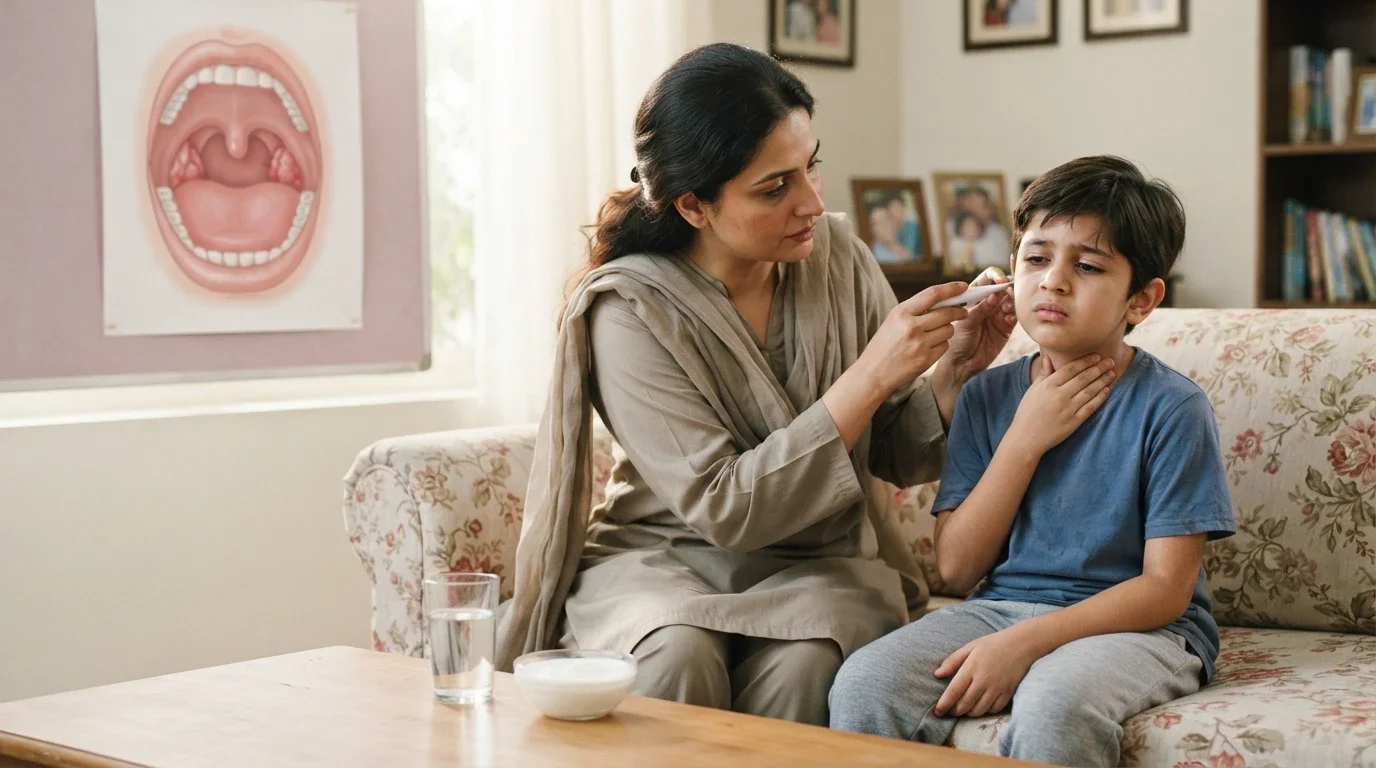
It is 3 a.m. and seven-year-old Hamza is standing beside his mother’s bed. “Ammi, my throat hurts when I swallow. It feels like glass.” His forehead is warm, his voice is hoarse, and he refuses even a sip of water.
Every parent knows this moment. You want to help right away, but you also want to avoid overreacting. Is this an ordinary sore throat that rest and fluids will fix? Or is it tonsillitis that needs a doctor? And if it is, will your child need antibiotics?
This guide answers those questions in plain language. It covers how to recognise tonsillitis, what you can safely do at home, the warning signs that should never wait, how recurrent infections are managed, and where homeopathic care fits in.
What Is Tonsillitis?
Tonsillitis is inflammation of the tonsils, the two small glands at the back of the throat that help the body fight germs. In children, the tonsils often become red and swollen when a virus or bacteria infects the throat.
Most cases are viral. The UK’s NHS notes that most children and adults get viral tonsillitis, which clears up on its own, while bacterial tonsillitis may need antibiotics prescribed by a doctor.
The bacterium most often behind a bacterial throat infection is group A Streptococcus, commonly called strep throat. According to the US Centers for Disease Control and Prevention (CDC), only around 3 in 10 children with a sore throat have strep. It is most common in children aged 5 to 15 and rare in children under 3.
Why children, and why now?
Children spend their days in classrooms, vans and playgrounds where germs pass easily from hand to hand and cup to cup. Winter and the change of seasons often bring a rise in throat infections. Their immune systems are also still learning, which is why tonsillitis is so much more common in childhood than in adulthood.
You may hear that cold drinks or ice cream cause tonsillitis. Infections come from germs that spread between people, not from temperature alone, and many children actually find cool soft foods soothing.
Symptoms of Tonsillitis in Children
Common signs
- A sore throat, often worse when swallowing
- Red, swollen tonsils, sometimes with white or yellow patches
- Fever
- Tender, swollen glands in the neck
- Bad breath
- A hoarse or muffled voice
- Headache or earache
The CDC adds that stomach pain, nausea and vomiting can also occur in children, and a sandpaper-like rash may signal scarlet fever, which is linked to strep.
In younger children
Toddlers and preschoolers cannot tell you their throat hurts. Instead you may notice:
- Refusing food or drink, or drooling
- Unusual crying and irritability
- A fever that does not seem to have another cause
- Pulling at the ears
The Colorado Department of Public Health notes that children younger than 3 with strep often have a persistent runny nose, fever, irritability and poor appetite rather than a classic sore throat.
Viral or bacterial? The clues
No parent can tell for certain by looking, and white spots do not prove bacteria. Still, patterns can help you describe your child’s illness to a doctor.
More typical of a viral throat infection | More typical of strep (bacterial) | |
|---|---|---|
Onset | Gradual, with a cold | Sudden sore throat |
Other symptoms | Cough, runny nose, hoarse voice | Fever, painful swallowing, swollen neck glands, no cough |
Age | Any age, including toddlers | Mostly 5 to 15 years |
A doctor can often judge from your child’s history and a look in the throat, and may do a throat swab to check for bacteria. The CDC says healthcare providers can do a quick test to see whether a sore throat is strep.
Home Care: What You Can Do Right Now
If your child has no warning signs (see the next section), supportive care at home is the standard first step. Health services such as the NHS recommend rest and plenty of fluids, with paracetamol or ibuprofen for pain and fever.
- Encourage small, frequent sips. Water, diluted juice, coconut water, soup and oral rehydration solution all count. Dehydration is the main risk when swallowing hurts.
- Offer soft, cool or lukewarm foods. Yoghurt, custard, mashed banana, khichri, ice pops and smoothies slip down easily. Avoid very spicy, sour or crunchy foods that scrape the throat.
- Give pain relief carefully. Use paracetamol or ibuprofen as directed on the label for your child’s weight and age. Do not give aspirin to children unless a doctor prescribes it, and do not double up on products that contain the same ingredient.
- Try honey for children over one year. A teaspoon of honey can coat and soothe an irritated throat. Never give honey to babies under 12 months.
- Use warm salt water for older children. Children who are old enough to gargle and spit can try a quarter teaspoon of salt in a glass of warm water. Do not force a young child.
- Add moisture and rest. A humid room and plenty of sleep help the body recover. Keep your child home from school until the fever has gone and they feel well.
- Practise good hygiene. Wash hands, avoid sharing cups, spoons and toothbrushes, and replace the toothbrush after the illness.
- Watch and note. Take your child’s temperature with a digital thermometer and jot down times, fluids and symptoms. You will be glad of this record if you need to call a doctor.
Most children with viral tonsillitis improve within a few days to a week. Hospital information leaflets from England’s NHS describe symptoms as usually going away by themselves in 3 to 4 days, and NHS guidance says to see a doctor if the symptoms do not go away within a week or the infections keep returning.
Where Homeopathy Fits
Many Pakistani families like to include homeopathy in their child’s care, particularly for recurring throat and cold complaints. It helps to be clear and honest about what it can and cannot do.
Some small studies have looked at homeopathic treatment for tonsillitis in children. One randomised trial of 40 children aged 3 to 7 with recurrent tonsillitis reported fewer episodes with homeopathic treatment than with placebo. Studies like this are very small, and the US National Center for Complementary and Integrative Health states there is little evidence that homeopathy works for any specific health condition.
So the sensible approach is this:
- Homeopathy is a supportive choice, not a replacement for diagnosis. A child with a bacterial infection may need antibiotics, and delaying them can have serious consequences.
- Get the child examined first when the sore throat is severe, comes with a high fever, or lasts more than a few days.
- Choose a qualified practitioner and a verified manufacturer. Our guide on when to see a practitioner before ordering homeopathic medicine explains what to check, and our article on using homeopathic and allopathic medicines together explains how to tell your doctor about everything your child takes.
- Follow label directions and our dosage guide.
You can browse the Kids Range or read our related guides on children’s fever and cold, weak immunity in children and adenoids in children, which often travel alongside frequent tonsil problems.
When Medical Treatment Is Needed
Go to a hospital or doctor urgently if your child has:
- Difficulty breathing, noisy breathing or a high-pitched sound when breathing in
- Drooling, or cannot swallow even saliva
- Difficulty opening the mouth, a muffled voice, or swelling to one side of the throat (possible quinsy, a collection of pus beside the tonsil)
- A stiff neck, severe headache or unusual drowsiness
- Signs of dehydration, such as no urine for many hours, a very dry mouth or sunken eyes
- A rash that does not fade when pressed, or a child who looks very unwell or limp
NHS advice also says to get urgent help if the throat is so painful that it is hard to eat or drink, or if there are pus-filled spots on the tonsils.
See a doctor within a day or two if:
- Your child has a high fever and a sudden severe sore throat with swollen neck glands
- The sore throat is not improving after about a week, or keeps returning
- Your child is under 3 with fever and poor feeding
- Someone at home has strep throat or your child has had rheumatic fever before
What about antibiotics?
Antibiotics do not work on viruses. Because most tonsillitis is viral, many children never need them. Health services in the UK note that antibiotics rarely speed recovery in most children and can cause side effects such as rash and diarrhoea.
If a swab or the doctor’s assessment shows strep, antibiotics are important. Public health agencies including the CDC and several health departments stress completing the entire course, even after your child feels better. This lowers the chance of complications such as rheumatic fever, a serious illness that can affect the heart and joints, and of kidney inflammation. A typical strep course is around 10 days, though the doctor decides the exact length.
Two cautions: never give leftover antibiotics from a previous illness, and never stop early because your child seems well.
When can my child return to school?
Rules differ, but with strep infection health authorities commonly advise waiting until the child has had at least 12 to 24 hours of antibiotics and the fever has gone. Ask your doctor, and keep your child home while they have a fever.
Recurrent Tonsillitis and Tonsil Removal
Some children seem to get tonsillitis again and again. Surgery to remove the tonsils (tonsillectomy) can help in selected cases, but guidelines are careful about when it is justified.
The American Academy of Otolaryngology, Head and Neck Surgery recommends watchful waiting if a child has had fewer than 7 episodes in the past year, fewer than 5 episodes a year for 2 years, or fewer than 3 a year for 3 years. Tonsillectomy may be considered at or above those frequencies when each episode is documented in the medical record with features such as a fever above 38.3°C, swollen neck glands, tonsil pus or a positive strep test. Other factors, such as repeated antibiotic allergies or a history of more than one peritonsillar abscess, can also be considered.
This is why a throat diary is so valuable. For each episode, write down:
- The date and how long it lasted
- The highest temperature
- Symptoms and whether the tonsils had pus
- Any swab result
- Medicines given, including antibiotics
- Days missed from school
Take the diary to your doctor or an ear, nose and throat specialist. It turns a vague “he gets it all the time” into information a specialist can act on. Persistent snoring, pauses in breathing at night or mouth-breathing can also point to enlarged tonsils or adenoids and should be discussed with a doctor.
Using Technology Sensibly
A digital thermometer, a phone note or app for your throat diary, and a video consultation with a paediatrician can all make a throat infection easier to manage, especially if the nearest clinic is far away. A doctor on video can listen to your history and decide whether your child needs to be seen in person or swabbed.
But a screen cannot look at the back of a throat, check for neck swelling or listen to breathing. And an AI chatbot cannot examine your child. Use these tools to prepare and to get advice, not to replace an examination when your child has a high fever or severe pain.
A Quick Traffic-Light Guide for Parents
Green: manage at home and watch closely
- Mild sore throat, low-grade fever, cough or runny nose
- Your child is drinking, passing urine and playing a little
- Improvement within a few days
Amber: arrange a doctor’s visit soon
- High fever with sudden severe sore throat and swollen neck glands
- Pus on the tonsils or very painful swallowing
- No improvement after about a week, or frequent repeat infections
- Younger than 3 with fever and poor feeding
Red: seek urgent care now
- Breathing difficulty, drooling, inability to swallow saliva
- Stiff neck, severe drowsiness or a rash that does not fade when pressed
- A one-sided throat swelling, trouble opening the mouth or signs of dehydration
Conclusion: Calm, Informed and Ready
Back to Hamza. In the morning his mother offers cool yoghurt and small sips of water, gives paracetamol at the correct dose, and checks his throat in the daylight. His fever settles within two days and he is back at school by the weekend. If it had lingered, he had pus on his tonsils or he could not drink, she would have called the doctor that day.
That is the real lesson. Most childhood tonsillitis is mild and passes with care at home, but a few cases need quick medical attention and a full course of antibiotics. Learn the warning signs, keep a diary, and treat homeopathic and home remedies as supportive steps alongside, not instead of, a proper diagnosis.
If you have questions about a product from Warsan’s Kids Range, reach us through the contact page or on WhatsApp (+92 311 2255820). For any red-flag symptom, go straight to a doctor or hospital.
This article is for general information and is not a diagnosis or a substitute for professional medical advice.