


Walk into any homeopathic pharmacy in Lahore, Karachi, or Islamabad and you’ll usually be offered a choice: a locally manufactured remedy or an imported one, often at a noticeably higher price. For many Pakistani households, this raises a genuine question — is local vs imported homeopathic medicine in Pakistan really a matter of quality, or mostly one of price and packaging? This guide breaks down how the two compare, what actually affects the safety and effectiveness of a homeopathic remedy, and how to make an informed choice for your family.
Why This Comparison Matters to Pakistani Consumers
Homeopathy has a long history in Pakistan, with both domestic manufacturers and imported European brands available in pharmacies and online stores nationwide. Imported homeopathic products, largely originating from Germany and other parts of Europe, are often perceived as more “authentic” simply because homeopathy originated in Germany in the early 1800s. Locally manufactured products, on the other hand, are sometimes assumed — without real basis — to be lower quality, mainly because they cost less.
This assumption doesn’t hold up well under scrutiny. Manufacturing origin and manufacturing standard are two different things. A product can be imported and still vary in quality control between batches, just as a locally produced one can be manufactured to strict, certified standards. The real questions worth asking are: How is the medicine manufactured? Is the facility certified? Is the formulation consistent? And is it priced fairly for what it delivers?
How Local Homeopathic Manufacturing Works in Pakistan
Local homeopathic manufacturers in Pakistan, including established names like Warsan Homoeopathic, produce medicines domestically using pharmacopoeia-standardized methods — the same core homeopathic principles (serial dilution, succussion, and standardized potencies such as CH, X, and LM scales) used anywhere else in the world. Warsan Homoeopathic Laboratories, for instance, has been manufacturing and exporting homeopathic medicine since 1977, and operates as an ISO 9001:2015 and GMP (Good Manufacturing Practice) certified facility based in Lahore.
What this means practically:
- Quality control happens on Pakistani soil, so batch consistency and freshness checks are closer to the point of sale, rather than relying on a long import and storage chain.
- Formulations follow the same recognized homeopathic pharmacopoeia standards used internationally — the underlying science of dilution and potency doesn’t change based on country of manufacture.
- Regulatory oversight for pharmaceutical and homeopathic manufacturers in Pakistan falls under national drug regulatory frameworks, which local manufacturers must comply with to legally sell and export their products.
How Imported Homeopathic Medicine Reaches Pakistan
Imported homeopathic products typically come through authorized distributors or resellers who bring in stock manufactured abroad — most commonly from German or other European homeopathic pharmaceutical houses. These products often carry strong brand recognition because homeopathy’s roots trace back to Germany, and some of these companies have been operating for over a century internationally.
However, a few practical factors are worth understanding:
- Import costs add up. Customs duties, shipping, currency conversion, and distributor margins are all built into the shelf price — which is a major reason imported homeopathic medicine tends to cost noticeably more than locally manufactured equivalents.
- Supply chains are longer. More steps between manufacturing and the shelf can mean longer time-to-market, and in some cases, less flexibility to restock quickly during high demand (for example, during flu season).
- Authentication matters more. Because imported products pass through multiple resellers, verifying that you’re buying from an authorized distributor — rather than an unofficial or grey-market source — becomes an important step for the consumer.
Local Manufacturing vs. Imported Brands: A Side-by-Side Look
Factor | Local Manufacturing (e.g., Warsan) | Imported Brands |
Price | Generally more affordable, fewer import costs | Higher, due to shipping, duties, and distributor margins |
Availability | Wider, faster restocking through domestic supply chains | Can be inconsistent depending on import cycles |
Manufacturing standards | Should be verified via certifications (ISO, GMP) | Should also be verified — origin alone isn’t a quality guarantee |
Consumer support | Easier direct access to the manufacturer for queries | Support often routed through the local distributor, not the original company |
Halal considerations | Some local manufacturers offer Halal-certified options | Certification status varies by brand and product |
The table above isn’t meant to declare one category universally “better” — it’s meant to show that the deciding factors are certification, consistency, and value, not simply the word “imported” on the label.
What Actually Determines Homeopathic Medicine Quality
Regardless of whether a homeopathic remedy is manufactured locally or imported, quality generally comes down to the same core factors:
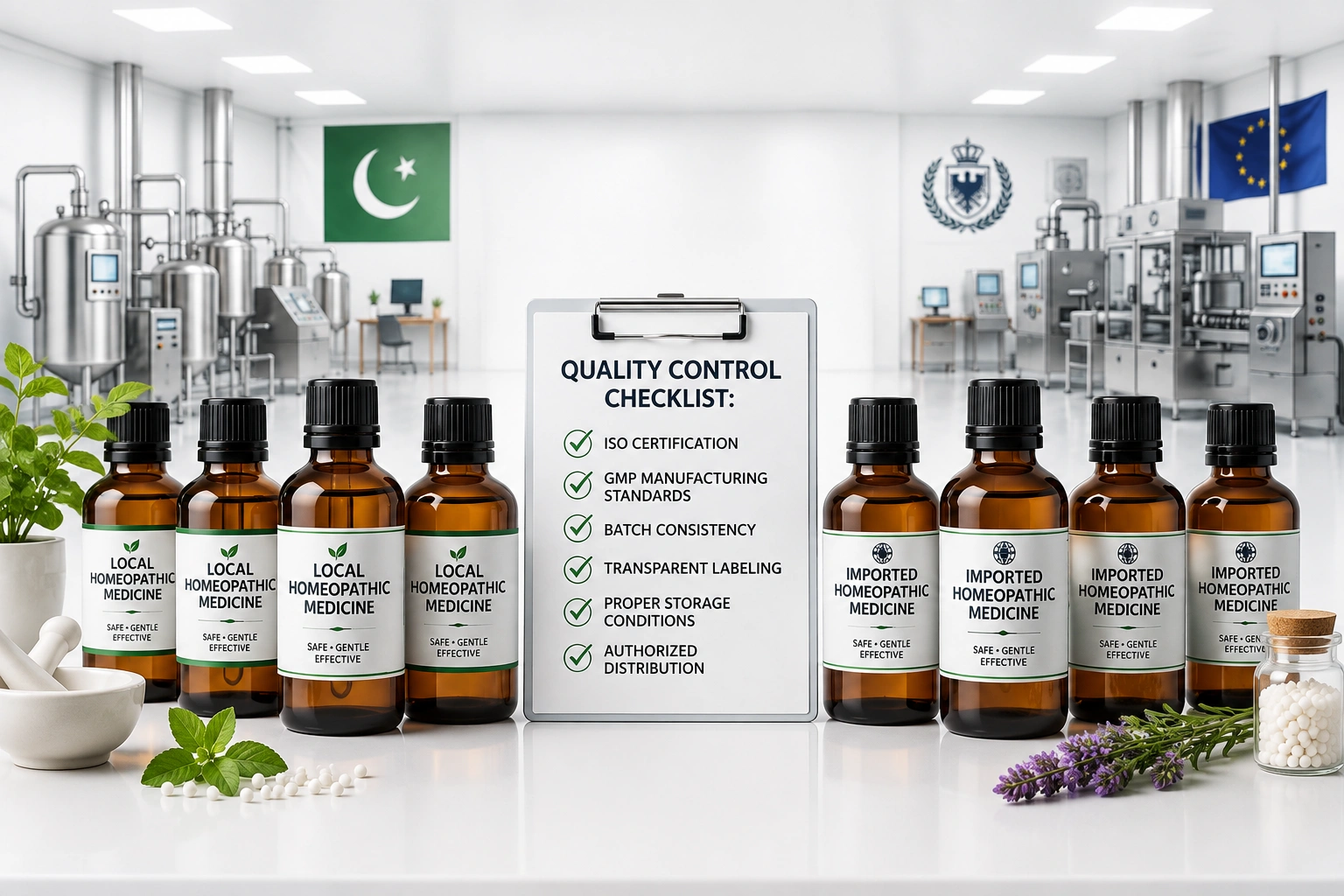
- Certified manufacturing practices — Look for ISO and GMP certification, which indicate the facility follows recognized quality management and hygiene standards.
- Consistent dilution and potency preparation — Reputable manufacturers, local or international, follow standardized pharmacopoeia methods for preparing dilutions and mother tinctures.
- Proper storage and handling — Homeopathic remedies can be sensitive to heat, light, and strong odors; poor storage during a long import journey can affect a product just as much as poor storage at a local pharmacy.
- Transparent labeling — Clear information on potency, ingredients, and usage instructions on the packaging, regardless of country of origin.
- Authorized distribution — Buying through the manufacturer’s official website, verified pharmacies, or authorized resellers reduces the risk of counterfeit or mishandled products — a risk that applies to both local and imported medicine.
Affordability: Why It Matters for Pakistani Households
For many families across Pakistan, especially those managing chronic or recurring conditions that call for ongoing homeopathic support — such as seasonal allergies, digestive issues, or general wellness tonics for children — affordability is not a minor detail. It directly affects whether a household can maintain consistent treatment.
This is where affordable homeopathic medicine in Pakistan, produced through domestic manufacturing, plays a practical role. Local production removes several cost layers that imported products inevitably carry, which allows manufacturers like Warsan to offer a broad range of products — from Kids Range and Women’s Health formulations to Bone, Joint, and Respiratory support — at prices more households can sustain over time, without necessarily compromising on certified manufacturing standards.
A Practical Example
Consider a Pakistani parent shopping for a general immunity tonic for their child. On the pharmacy shelf, they see two options: an imported bottle priced significantly higher, and a locally manufactured, GMP-certified alternative from a Pakistani brand at a more accessible price. Rather than assuming the imported bottle is automatically superior, a more useful approach is to check both products for certification marks, batch information, and clear usage instructions — then make the decision based on those factors and the family’s budget, ideally after discussing options with a qualified homeopathic practitioner or pharmacist. This is a hypothetical scenario meant to illustrate the kind of comparison worth making, not a specific case study.
When to Consult a Professional
Homeopathic remedies, whether locally manufactured or imported, are generally used to support mild, self-limiting, or chronic wellness concerns. They are not a substitute for emergency care or professional medical diagnosis. If symptoms are severe, persistent, worsening, or involve children, pregnant women, or existing chronic conditions, it’s important to consult a qualified homeopathic practitioner or medical doctor before starting or changing any treatment — regardless of which brand or origin the product comes from.
Making the Right Choice for Your Family
There isn’t a single universal answer to “local vs. imported” — the right choice depends on your specific needs, budget, and the certification credibility of the specific product in front of you. What matters most is:
- Choosing a manufacturer (local or imported) that is transparent about its certifications and manufacturing standards.
- Comparing real value — price relative to certified quality — rather than assuming origin equals quality.
- Buying through authorized channels to avoid counterfeit or mishandled products.
- Consulting a professional for anything beyond mild, everyday wellness support.
For many Pakistani households, a certified local manufacturer offers a practical middle ground: pharmacopoeia-standard preparation, domestic quality oversight, and pricing that supports consistent, long-term use — without the added cost layers that come with importing.
.
Frequently Asked Questions
Q1: Is imported homeopathic medicine always better quality than local homeopathic medicine in Pakistan?
Not necessarily. Quality depends on certified manufacturing practices (such as ISO and GMP standards), consistent preparation methods, and proper storage — not simply on whether a product was manufactured locally or imported. Both categories can vary in quality, so checking certifications is more useful than relying on country of origin alone.
Q2: Why is local homeopathic medicine usually cheaper than imported brands in Pakistan?
Imported products carry additional costs such as shipping, customs duties, currency conversion, and distributor margins, all of which are added to the shelf price. Locally manufactured medicine avoids most of these extra costs, which is a major reason it tends to be more affordable for Pakistani households.
Q3: How can I check if a homeopathic manufacturer, local or imported, is genuinely certified?
Look for visible ISO and GMP certification information on the manufacturer’s website or product packaging, and buy only through the manufacturer’s official website or authorized, verified pharmacies. Avoid unofficial resellers, especially for imported products, where verifying authenticity is harder.
Q4: Can I trust locally manufactured homeopathic medicine for children?
Locally manufactured products from certified manufacturers follow the same standardized dilution and potency preparation methods used internationally. That said, for children, it’s always advisable to consult a qualified homeopathic practitioner or pediatrician before starting any new remedy, regardless of whether it’s local or imported.
Q5: Does “Halal-certified” homeopathic medicine only apply to local Pakistani brands?
Halal certification can technically apply to any manufacturer, local or international, that meets the relevant certification requirements. In practice, some local Pakistani manufacturers actively pursue and highlight Halal certification as part of their product transparency, which may be an important factor for some households when choosing between local and imported options.
Conclusion
Choosing between local and imported homeopathic medicine in Pakistan doesn’t have to come down to assumption or brand perception. The factors that genuinely matter — certified manufacturing, consistent quality control, transparent labeling, and authorized distribution — apply equally to both categories. For households prioritizing affordability without giving up certified quality, domestically manufactured homeopathic medicine offers a practical, accessible option, provided it comes from a properly certified