



A 32-year-old woman from Rawalpindi had been dealing with recurring UTIs for nearly two years. Every few months, the same pattern: burning on urination, a constant urgent need to go, and lower abdominal pressure that made daily life unbearable. Each time, she’d visit her doctor, get antibiotics, improve within days — and then, a few months later, it would start again. She came to us asking whether homeopathy for UTI in Pakistan could break the cycle, not just treat the latest episode.
Urinary tract infections (پیشاب کی نالی کا انفیکشن) are among the most common bacterial infections worldwide, and in Pakistan they’re significantly underreported — particularly among women who feel uncomfortable discussing urinary symptoms openly. Conservative estimates suggest that one in two women in Pakistan will experience a UTI at some point in her life, with a substantial proportion developing recurrent infections.
The challenge with repeated antibiotic courses isn’t just resistance — it’s that they address the infection without addressing why it keeps returning. In this article, you’ll learn which homeopathic remedies have the strongest clinical grounding for UTI, how to use them effectively, and how to approach the underlying constitutional tendency that makes recurrence so common.
What Is a UTI — and Why Do So Many Pakistanis Suffer From It?
A urinary tract infection (پیشاب کی نالی کا انفیکشن) occurs when bacteria — most commonly E. coli from the gut — enter the urethra and multiply in the bladder. If untreated, infection can ascend to the kidneys, becoming a more serious condition called pyelonephritis. Symptoms include a burning or stinging sensation during urination, a persistent and often urgent need to urinate even when the bladder is near-empty, cloudy or strong-smelling urine, and sometimes lower abdominal discomfort or fever.
Women are far more susceptible than men, primarily due to anatomical differences — a shorter urethra means bacteria have less distance to travel to reach the bladder. In Pakistan, additional factors amplify the risk considerably.
Dehydration is a major driver. In cities like Multan, Hyderabad, and Sukkur during summer, people frequently consume less than a litre of water daily — far below the threshold needed to flush the urinary tract effectively. Synthetic undergarments that trap moisture, inadequate access to clean washroom facilities, and cultural hesitation around discussing urinary symptoms all contribute to delayed treatment and recurring infection.
Postmenopausal women carry particularly high risk, as declining oestrogen thins the urethral and vaginal tissue, reducing the body’s natural defence against bacterial colonisation. Diabetic patients in Pakistan — a rapidly growing population — also face elevated UTI risk due to glucose in the urine creating a hospitable bacterial environment.
Understanding these risk factors matters because the best homeopathy for UTI in Pakistan addresses not just the infection itself, but the constitutional and environmental factors that allow infections to take hold and recur.
How Does Homeopathy Help with UTI?
Homeopathy works on the principle of “like cures like” — a substance that produces symptoms in a healthy person can, in highly diluted form, stimulate the body to resolve those same symptoms. For urinary infections, the remedy is selected based on the precise character of the burning, the urgency pattern, the type of discomfort, and the emotional and constitutional state of the patient — not simply the diagnosis.
This specificity is what distinguishes homeopathic treatment from a blanket antibiotic course. A woman with severe burning before and during urination, extreme urgency, and restless anxiety presents a completely different symptom picture from one who has a slow, dull aching in the bladder with very little urgency but constant awareness of the infection. Each requires a different remedy — and that individualisation is where homeopathy earns its clinical reputation.
At Warsan Homoeopathic Laboratories, we’ve observed this pattern consistently over nearly five decades of practice. Patients with recurrent UTIs who receive carefully matched constitutional treatment often experience not just resolution of the active infection but a genuine reduction in recurrence frequency — sometimes stopping entirely. The mechanism isn’t antibacterial in the conventional sense. It’s that the constitutional remedy corrects the immune and mucosal vulnerability that makes the person susceptible in the first place.
This is a meaningful distinction from natural UTI treatment without antibiotics that simply lists herbs. Homeopathy aims to change the terrain — the conditions in which infection keeps finding a foothold.
Top Homeopathic Remedies for UTI in Pakistan
Cantharis Vesicatoria (30C)
Cantharis is the first remedy most experienced homeopaths reach for in acute UTI — and with good reason. The cantharis for bladder infection picture is unmistakable: intense burning and cutting pain before, during, and after urination, an almost constant urge to urinate with only small amounts passing each time, and a sense of intolerable urgency that dominates the patient’s entire experience. The burning may extend from the urethra up into the bladder, and patients are often restless and distressed. This is the most directly indicated remedy for the acute inflammatory phase of a lower UTI. Dose: 30C every 1–2 hours during acute symptoms, reducing to three times daily as symptoms ease.
Apis Mellifica (30C)
Apis suits UTI presentations where stinging, burning pain is accompanied by marked swelling and heat sensations — the urine may be scanty and the patient is often thirsty but paradoxically better for cold applications. There’s typically a complete absence of thirst (unusual in most infections) and a sensitivity to heat. This remedy is particularly useful for the inflammatory type of cystitis where the bladder feels swollen and tender. It’s also one of the urinary infection holistic remedy options that works well in postmenopausal women with thinning mucosal tissue. Dose: 30C every 2–3 hours in acute phase.
Staphysagria (30C)
Staphysagria is the classic remedy for “honeymoon cystitis” — UTI triggered by sexual activity — and for infections that follow catheterisation, gynaecological procedures, or any perceived violation of personal boundaries. The symptom picture includes burning in the urethra even between urinations, and the patient may experience a sensation as though a drop of urine is constantly trickling out. Emotionally, Staphysagria patients often suppress anger or feel a deep sense of indignation — this emotional component is clinically significant and part of why the remedy works so well for this presentation. Dose: 30C twice to three times daily.
Berberis Vulgaris (Q or 6X)
While Berberis is best known for kidney stones, it has a strong indication in urinary infections where the pain radiates from the kidneys down toward the bladder and there’s associated backache. When a UTI feels like it’s involving the upper urinary tract — with flank tenderness and aching across the lower back — Berberis is often the most appropriate choice. It supports both the urinary tract and the kidneys simultaneously, making it particularly useful when there’s concern that infection may be ascending. Dose: Q (10 drops in water, three times daily) or 6X twice daily.
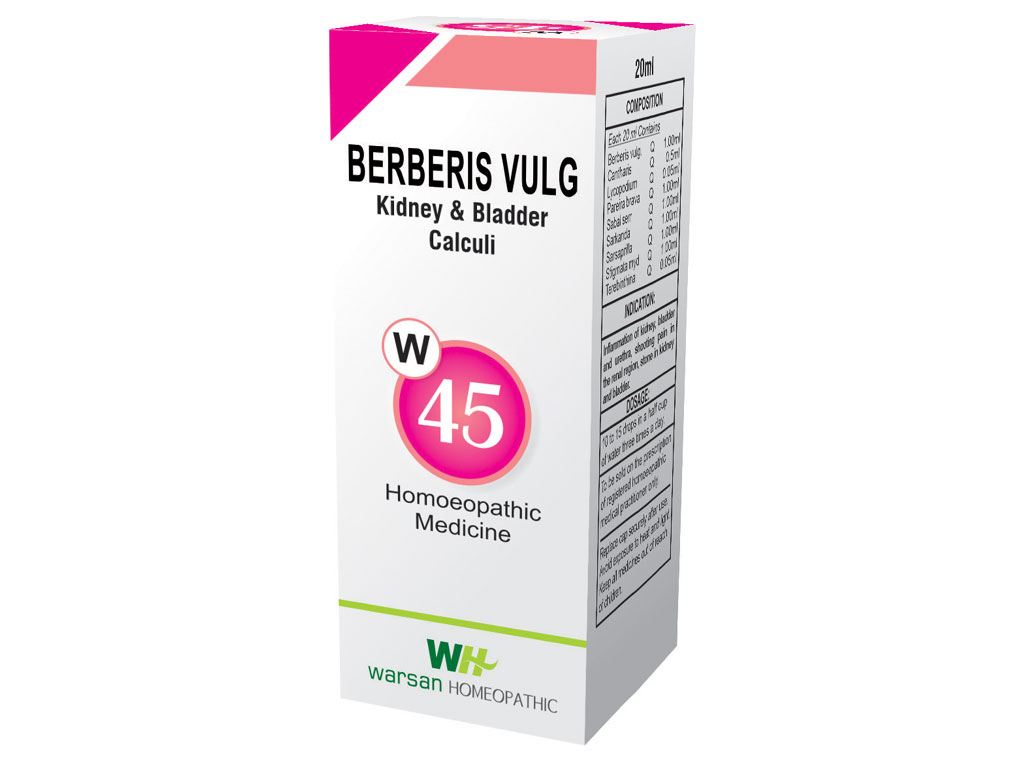
Warsan No. 45 (Berberis vulg) 20ml
Pulsatilla Nigricans (30C)
Pulsatilla suits UTIs in women who have changeable, shifting symptoms — the burning may be variable rather than constant, the urge to urinate is worse when lying down or in a warm room, and emotionally the patient tends toward tearfulness and a desire for comfort and consolation. This remedy is frequently indicated in young girls and adolescents with their first UTIs, and in women whose urinary symptoms fluctuate with hormonal cycles. It’s one of the most important urinary infection holistic remedy options in constitutional prescribing for women. Dose: 30C twice to three times daily.
Equisetum Hyemale (Q or 6X)
Equisetum — derived from horsetail — is specifically indicated when there is a persistent feeling of fullness in the bladder that is not relieved by urination, even after the bladder has been emptied. There’s often dull pain and pressure in the right side of the bladder, and the remedy is particularly suited to chronic cystitis that lingers after the active infection has cleared. It works well as a longer-term supportive tonic for patients who have recurrent UTIs and chronic bladder irritability. Dose: Q (10 drops twice daily) or 6X twice daily.
💡 Expert Tip: For recurrent UTIs in women, Staphysagria as a constitutional remedy — prescribed based on the full emotional and physical picture — often addresses the root susceptibility rather than just the active infection. If a patient has had three or more UTIs in a year, an acute remedy for each episode is not enough. Constitutional prescribing is what changes the pattern. This requires a proper case-taking, not a remedy selection from a list.
🌿 Warsan Product Recommendation
Looking for a ready-made formulation? Warsan Homoeopathic’s Urinary Tract Relief Formula combines the most clinically effective bladder infection remedies — including Cantharis, Berberis Vulgaris, and Equisetum — into a single GMP-certified preparation suited for both acute UTI relief and ongoing urinary tract support.
You can explore and order this product at warsan.com.pk, with delivery available across Pakistan including Lahore, Karachi, Islamabad, Rawalpindi, Faisalabad, and Peshawar.
For women with recurrent UTIs specifically, we recommend pairing any ready-made formulation with a practitioner consultation to identify the correct constitutional remedy. Warsan Homoeopathic offers both in-person and online consultation options for patients across Pakistan.
This recommendation is for informational purposes. Please consult a qualified practitioner, especially if symptoms include fever or back pain suggesting kidney involvement. Results may vary.
How to Use Homeopathic Remedies — Dosage, Timeline & Lifestyle Tips
Getting the practical details right is what separates a remedy that works from one that disappoints. Here’s what clinical experience consistently shows for homeopathy for UTI in Pakistan.
Frequency reflects severity. In an acute UTI, remedies like Cantharis and Apis should be taken frequently — every 1–2 hours while symptoms are intense, reducing to three times daily as the burning and urgency ease. Many patients make the mistake of taking a 30C once a day and expecting dramatic results. Acute conditions require frequent dosing until symptoms visibly shift.
Hydration amplifies every remedy. Drinking 3–4 litres of water daily during an active UTI is not optional — it dilutes bacterial concentration in the bladder and supports whatever remedy you’re taking. In Pakistan’s summer heat, this often means consciously setting hourly reminders. Sabzi ka paani (vegetable broth) and coconut water are excellent supplementary hydrators.
Avoid triggers during treatment. Strong tea, excessive spice, and carbonated drinks all irritate the bladder lining and can prolong symptoms. Reducing chai consumption to one cup daily during active infection — and replacing it with plain water or barley water — is a realistic and effective adjustment for most Pakistani patients.
Timeline. Acute UTI symptoms typically begin to ease within 12–24 hours of a well-matched remedy. If there’s no improvement after 24 hours, the remedy selection likely needs to be reconsidered. Recurrent UTI prevention through constitutional treatment requires a minimum of 3 months of regular prescribing.
Did You Know? E. coli — the bacterium responsible for over 80% of UTIs — forms biofilms on the bladder wall that can persist even after antibiotic treatment clears the active infection. This is one reason UTIs recur so predictably. Homeopathic remedies, by supporting the body’s mucosal and immune response rather than targeting the bacteria directly, may help disrupt this recurrence cycle at a different level.
Common Mistakes That Prevent Recovery
Even the most carefully chosen natural UTI treatment without antibiotics will fall short if these avoidable errors remain in place.
Treating each episode in isolation. This is the most common and consequential mistake in recurrent UTI management. Taking Cantharis for three days, recovering, and then starting again from scratch at the next infection is a maintenance approach, not a cure. The underlying susceptibility — whether constitutional, hormonal, or anatomical — never gets addressed. A practitioner who sees recurrent UTI patients needs to look beyond the acute prescription to the constitutional picture.
Delaying treatment when symptoms include fever or back pain. Lower UTI symptoms — burning, urgency, frequency — are appropriate for homeopathic management. But fever, rigors, nausea, or flank pain indicate that infection may have ascended to the kidneys. Pyelonephritis requires urgent medical evaluation and very likely antibiotics. Continuing only with homeopathic treatment in this scenario risks serious renal damage. Know the warning signs and act on them.
Using high potency remedies too frequently in chronic cases. Patients sometimes take 200C or 1M potencies multiple times a day because they feel it will work faster. In chronic and recurrent conditions, high potencies dosed too frequently can cause unwanted aggravations. Reserve high potencies for constitutional prescribing under practitioner supervision — stick to 30C for acute self-management.
Ignoring hygiene and anatomical factors. No remedy overcomes consistent hygiene lapses. Wiping front-to-back, urinating after sexual activity, and changing out of synthetic underwear promptly after sweating are non-negotiable habits that directly reduce recurrence risk.
Homeopathy vs. Conventional Medicine — A Fair Comparison
Antibiotics remain the standard of care for confirmed bacterial UTI — and for good reason. For an acute lower UTI caused by E. coli, a three-to-five-day course of nitrofurantoin or trimethoprim clears the infection reliably, quickly, and safely. For kidney involvement, intravenous antibiotics may be necessary. These are tools that save kidneys and prevent sepsis, and they shouldn’t be dismissed.
The problem arises in the management of recurrent UTIs, where repeat antibiotic courses progressively select for resistant bacterial strains and disrupt gut and vaginal microbiome balance — ironically making future infections more likely. It’s in this population that natural UTI treatment without antibiotics has the most to offer.
Homeopathy doesn’t kill bacteria. What it does — when prescribed constitutionally — is support the body’s own immune and mucosal defences, address emotional and hormonal factors that perpetuate susceptibility, and reduce the frequency and severity of future infections. Used alongside conventional medicine — antibiotics when necessary, homeopathy for prevention and constitutional strengthening — the combined approach produces the best long-term outcomes.
At Warsan Homoeopathic, we never discourage patients from using antibiotics when clinically indicated. We encourage integration, not replacement.
This article is for educational purposes and is not medical advice. Please consult a qualified homeopathic practitioner.
Conclusion
Urinary tract infections in Pakistan are far more common than the reported numbers suggest — and for the millions of women who experience recurrent infections, antibiotics alone are not a long-term solution. Homeopathy for UTI in Pakistan works by matching the remedy to the precise symptom picture, addressing both the active infection and the underlying constitutional vulnerability that keeps the cycle going.
Three things to take forward: acute dosing frequency matters — remedies need to be taken every 1–2 hours in the early phase, not once a day. Fever or back pain is a red flag requiring immediate medical evaluation, not home treatment. And for recurrent UTIs, constitutional prescribing over 3–6 months is what changes the pattern, not just managing each episode as it arrives.
Frequently Asked Questions
1. Is homeopathy for UTI in Pakistan effective without antibiotics?
Homeopathy for UTI in Pakistan can be effective for mild to moderate lower urinary tract infections when the remedy is correctly matched to the symptom picture. Cantharis, Staphysagria, and Apis are among the most clinically reliable options. However, if symptoms include fever, back pain, or don’t improve within 24–36 hours, a urine culture and medical evaluation are necessary — some infections require antibiotics for safe resolution.
2. What is the fastest-acting homeopathic remedy for UTI?
Cantharis 30C is the most rapidly effective homeopathic remedy for acute UTI with intense burning and urgency. When dosed correctly — every 1–2 hours during the acute phase — many patients experience meaningful relief within 12–24 hours. The speed of response depends on how accurately the remedy matches the symptom picture and how promptly treatment is started after symptoms appear.
3. Can homeopathy treat UTI without antibiotics permanently?
Natural UTI treatment without antibiotics through homeopathy can help resolve individual episodes and, through constitutional prescribing, reduce the frequency of recurrence significantly. However, “permanently” is not a claim homeopathy makes — the goal is to correct the underlying susceptibility so the body becomes less vulnerable. Patients with anatomical risk factors, diabetes, or postmenopausal changes may still need conventional management for some episodes.
4. What is Cantharis used for in bladder infection treatment?
Cantharis for bladder infection is indicated when there is intense burning and cutting pain throughout the entire urination — before, during, and after — combined with an almost constant, intolerable urge to urinate with very little urine passing each time. It’s the most directly indicated remedy for the acute inflammatory phase of lower UTI and has one of the clearest and most recognisable symptom pictures in homeopathic practice.
5. Is there a homeopathic remedy specifically for women with recurrent UTIs?
Staphysagria 30C is the most important urinary infection holistic remedy for women with recurrent UTIs, particularly those triggered by sexual activity, emotional suppression, or a history of pelvic procedures. Pulsatilla is indicated when symptoms are variable and emotionally linked to hormonal changes. For postmenopausal women, Apis and Equisetum often address the mucosal thinning and chronic bladder irritability that increase susceptibility after menopause.
6. How long does homeopathic treatment take to clear a UTI?
A well-matched remedy for acute lower UTI typically begins to show results within 12–24 hours of correct dosing. Full resolution of symptoms usually occurs within 3–5 days. For chronic or recurrent UTIs, constitutional homeopathic treatment requires 2–4 months of consistent prescribing before meaningful reduction in recurrence frequency becomes apparent. Urine culture testing at appropriate intervals helps track whether infection has fully cleared.
7. Can I buy homeopathic UTI medicine online in Pakistan?
Yes, you can buy homeopathic medicine online in Pakistan through GMP-certified manufacturers like Warsan Homoeopathic at warsan.com.pk. Remedies like Cantharis 30C and Berberis Vulgaris Q are suitable for acute self-management of mild UTI symptoms. For recurrent infections or symptoms involving the kidneys, an online or in-person consultation with a qualified practitioner is strongly recommended before selecting a remedy.
8. When should I see a doctor instead of treating UTI with homeopathy?
See a doctor immediately if your UTI symptoms include fever above 38°C, chills, nausea or vomiting, pain in the upper back or flanks, or if symptoms worsen after 24–36 hours of homeopathic treatment. These signs suggest the infection may have spread to the kidneys, which requires urgent conventional medical care. Homeopathy is appropriate for uncomplicated lower UTI — not for suspected pyelonephritis or systemic infection.